The Swans of Our Youth

Most of us are familiar with the story of the ugly duckling by Hans Christian Andersen. We learn of it as children, whether read to us by a parent or teacher or seen in one of the animated versions available on television (to us old folks) or on-line for a younger generation.

It is a wonderful tale of transformation as a seemingly ugly duckling matures into a beautiful swan. The change comes as a blessed surprise as the homely protagonist emerges from a long winter of despair and alienation to be welcomed into the society of its own majestic kind.

The joy we feel on the duckling’s behalf clouds the issue, for me at least, that the animal wasn’t a duck at all. And this case of mistaken identity has nothing really to do with being ugly but about being rejected for being different. And while the intent of the author may have been one of making a symbolic statement about an inner transformation we all can experience, the truth is that it could only be told in this type of romantic format by acknowledging the harsh reality that we rank physical beauty as being supreme in our selection of the most desirable attributes.

For people maturity is not so kind. We age and the signs of our passage mark us in ways, which leave us humbled both in stature and visage. The swans of humanity appear in our youth, age being the untamed uglifier we wish to curtail with whatever cosmetic remedy is within our means to effect.

Cute kids may become adorable teenagers and beautiful young adults. But beyond those chronological boundaries, there be monsters. Weight, wrinkles and receding hairlines conspire with poor circulation and aching (needing to be replaced) joints to render us fatigued shadows of the swans of our youth.

My rant against this beloved fairytale of my youth, submitted here with all due to respect to Andersen’s creative genius, began with my own real life version of Driving Miss Daisy. It involved taking my mother on her once a week outings to dine out and to shop. As her strength declined, the shopping was easily sacrificed for the enjoyment of dining out and that usually a breakfast since mornings were the best part of her day. She came to eschew the use of makeup as a waste of time on a lost cause, except for one thing. She always put on lipstick before entering any restaurant. “Otherwise,” she said, “people will think I’m dead.”

It occurred to me that the story of the ugly duckling, though well intended, was false. We adults cannot ignore the gross inequities that come to us all as we age. It was once said of women, who did not marry while still teenagers or at most in their very early twenties, that they had been put on the shelf. We who are elders in the hyper-fast, high-intensity Facebook, Snapchat, Twitter era can commiserate with our spinster ancestors. Any marketing outreach targeting us concerns remedies for erectile dysfunction, high blood pressure and the joys of assisted living.

We are today’s ugly ducklings and the passage of another winter will not reveal our true nature as having the beauty of any graceful swan. We will spend our time looking at seed catalogues, planning next year’s garden, and relishing the maxim that hope springs eternal, Spring being the season which captures our flagging hopes in reincarnation here or in any heavenly realm promising us a chance at Nirvana.

The plastic surgeon is our Anderson. Both make their living spinning fairytales of surreptitious beauty.

Another Garden, Another Avenue to Walk

Since Eden, gardens have represented a most tranquil place in which we may find solace and wellbeing despite the conflicting currents of thought and action in the world about us. We plant them, the work of our own hands, creating on a modest scale the bliss and harmony of a lost chance at perfection. We visit them, the carefully crafted botanical gardens that grace many of our larger communities as an extension of our own dreams for peace and solidarity.

Some gardens are truly unique, touching on the divine purpose of their ancient ancestor. One such place is the Garden of the Righteous Among the Nations, which is part of the Yad Vashem museum complex in Jerusalem. The museum is a memorial to the victims of the Holocaust, its name derived from the Hebrew text of the Prophet Isaiah’s promise to eunuchs, those who had been mutilated in service to their masters and denied the privilege of generating new life, that they would one day know an abiding peace in the eternal presence of a just God.

We have similar museums and memorials in this country, even though they may not represent the scope of the horrific nightmare inflicted upon the Hebrew people living in Europe during the Nazi ascendency. The National September 11 Memorial and Museum in New York City and the Oklahoma City National Memorial are prime examples of our attempts at paying permanent tribute to the innocents, who died as a result of the same type of sinister mentality that troubled Europe when a conclave of hate was in session. Bricks and mortar, concrete and stone, such places rightfully honor the dead with the intent of showing the events to be so repugnant that such things will never happen again, even though they do.

The Garden of the Righteous Among the Nations represents something else, however. It was designed to honor those non-Jews who during the Holocaust risked their lives to save Jews from extermination by the Nazis. The Garden, itself a living monument, honors the living, who gave the precious gift of life to those who were powerless against the superman onslaught of what we now politely call ethnic cleansing. The Garden exemplifies something equally important for us to sustain in our collective memory in the way the Museum reminds us of the destructive nature of genocide and that is how to live and preserve life so that others may live and enjoy the same peace and security that we desire for ourselves.

The passage from which Yad Vashem draws its name is a truly inspired choice for the larger context in what the prophet of God proclaimed for all to hear includes a promise to non-Jews, foreigners who bind themselves to the Lord to serve him, to love the name of the Lord, and to worship him, all who keep the Sabbath without desecrating it and who hold fast to my covenant – these I will bring to my holy mountain and give them joy in my house of prayer. Their burnt offerings and sacrifices will be accepted on my altar; for my house will be called a house of prayer for all nations. The Sovereign Lord declares – he who gathers the exiles of Israel; I will gather still others to them besides those already gathered (Isaiah 56:6-8 New International Version). Appropriately, Yad Vashem is located on the western slope of Mount Herzl, reflecting God’s promise to bring all who keep his covenant to his holy mountain.

Part of the Museum complex is the Avenue of the Righteous. It was created on bare Mount Herzl on May 1, 1962 with the planting of eleven trees along the path leading to the Hall of Remembrance. Each tree was planted by the rescuer it honored in company with the Jews they rescued during the Holocaust. At the Avenue’s dedication, then Israeli Foreign Minister Golda Meir likened their efforts to drops of love in an ocean of poison. This living tribute to compassion’s persistent proclamation of human dignity has been supplemented over the years as more rescuers have been acknowledged by the designation of being Righteous, with more trees planted and more emphasis placed on what it means to be good. Just such a Garden and just such an Avenue  is what America needs right now as hate has once again taken center stage in the way we govern and in the way we protest such governance.

We have ample space for establishing a garden of major proportions with avenues aplenty along which we may walk and reflect on virtue and beauty. We have more than enough talented architects of nature, who can craft a perpetually growing sanctuary.  And no doubt there is a place in the heartland where a stream runs through undeveloped property, living water as opposed to a concrete pond, where the charm of Eden can once again be established in praise of a righteous cause. The trouble for us will be in deciding who are the righteous among us today? Our tendency towards worshipping at the altar of celebrity would make it likely that any selection committee would default to those who already have their halls of fame for keeping us entertained. The beauty of the Garden of the Righteous Among the Nations is that it honors ordinary people who did extraordinary things at great personal risk.

Since I lack the means of constructing this garden and these avenues of which I can only dream, perhaps I must be content to await the fulfillment of another prophecy, this one made by the Apostle John, a Jew, who was a proponent of the Way. While imprisoned by a ruthless empire whose power the Nazis could only envy, he saw a New Jerusalem established on the earth in a future where there will be no more death or mourning or crying or pain; no more barbed wire, gas chambers and human-fed furnaces or museums, which memorialize their infamy.

Instead, what John saw in the midst of the city were the elements of a garden reminiscent of the Eden, where we began. Of this vision he wrote, Then the angel showed me the river of the water of life, as clear as crystal, flowing from the throne of God and of the Lamb down the middle of the great street of the city. On each side of the river stood the tree of life, bearing twelve crops of fruit, yielding its fruit every month. And the leaves of the tree are for the healing of the nations (Revelation 22:1-2 New International Version).

Reflections Without Mirrors

When you are a guy and wish to or need to appear clean shaven, you spend a lot of time peering into a mirror while scrapping your face clean of any telltale bristle. It is during these times of self-inflicted facial abrasions that you see the physical flaws you cannot wipe away. The reflection confronting you in the mirror is harsh and unrelenting in its appraisal of the blemishes, which cannot be cured by the anemic virtues of any over the counter remedy. Reflections without mirrors, however, are far more malleable and therefore far less cruel in presenting us with blush free images.

I have spent a lot of time lately reflecting on the past, my past, with a bent towards the loneliness caused by absences, when loved ones leave home or leave life behind permanently. But the past has its own healing purposes as well and the reflections without mirrors that I am inclined to favor now show me images that are easily embraced for their reassuring pathos.

For as long as I can remember I have loved music and enjoyed singing. When I was a child my mother would merely say “Sing us a song” and I would launch right in to whatever song came to mind. It pleased her most when I sang a hymn, but not so much if I belted out a tune from a popular television commercial such as “What’ll you have? Pabst Blue Ribbon” or “You’re lucky if you live in America. Luck, Lucky Lager beer.” But while I was a passable singer in those days, I was absolutely not a musician.

I envied people who could play a musical instrument. I tried to play a few during my childhood; piano, saxophone and guitar. But I lacked the patience to practice and gave up on all three. Being outside was my heart’s desire and growing up in Southern California made being outside an alluring prospect year round.

It wasn’t until I was in college and met the girl I would one day marry that I determined to finally learn how to play the guitar. This was out of a simple but compelling notion that if the girl of my dreams could play, then I could too. Competition had been the basis of my existence all those years of outdoor activity, such as playing baseball with my friends. And now it served me well in my new commitment to play the guitar as well as my sweetheart did.

My technique for learning to strum basic chords was simple. I bought a book which showed the finger position for each chord and figured out that going from E major to E minor was about as simple a chord progression as one could make. It only requires the movement of your left index finger to make the change; press down for the major and lift for the minor. So I worked at that until the chords sounded clearly, which meant that my fingertips had calloused sufficiently to keep the tone from being dull. Then I worked at going from E minor to A minor, a step up in difficulty but still manageable. And then I added D major, D minor and A. All of these required the use of only three fingers, but once I was proficient at playing them I added C, G and F to incorporate the use of all four fingers, while my thumbed curved over the next of the guitar to press down the bass string. My ultimate attainment was being able to strum B minor 7 without fail.

During the first year of our marriage a good friend would come to our apartment on weekends and the three of us would play guitars and sing the popular songs we knew that made use of three part harmonies. Songs by Peter, Paul and Mary were favorites and easy to reproduce since we had the right gender combination. Then we added two songs by Crosby, Stills and Nash to our repertoire; Teach Your Children and Helplessly Hoping. At some point during that year we were joined by a friend from my wife’s college days, who lent his guitar playing rather than his vocal skills to our low-cost, living room floor show.

Both Du and Max were far more accomplished on the guitar than I was. They didn’t just strum chords, they picked when they played, which was a talent I sought to develop. And once again my methodology was to start simple by copying a style that was used by Leonard Cohen on many of his early songs that had what I would call a percussion-like feel to the fingering. But as I progressed and developed a picking style that was only slightly more sophisticated the sound I was hearing influenced the melodies I was able to conceive while indulging in that other fantasy of mine, being a singer-songwriter. One of those early compositions was entitled Where’s Jennie?

The origin of the lyric was inspired by the movie musical Camelot, which I thought was one of my wife’s favorites. That impression was based on her comment that she cried whenever she saw it. In the movie King Arthur’s pet name for Queen Guinevere was Jennie. So being young and in love I thought it quite romantic to occasionally call my wife Jennie as a way to show my affection for her and to acknowledge her passion for this particular musical.

Other allusions, which made it into the lyric, were based on things that happened or that we talked about during the early days of our marriage. My wife had and still has a propensity for going places and doing things without letting me know the when, where and why of her absence. She did and still does have a need for naps and she was typically the first of us to go to bed as I was the night owl of the family. So the thought that she might be sleeping also made it into the song.

Anyone who knows my wife knows that she cries easily. You will find a reference to that aspect of her character being used here. And my personal aspiration to someday own a wooden house as a symbol of our financial success is another element of the song, as is the fact that music was an important part of our life together. It was always with regret that those singalong sessions with friends came to an end. And you will find that sentiment mentioned here as well.

I compressed all of those elements together to form a lament that has remained a favorite of mine to this day. The irony is that it wasn’t until years later that I found out that my wife hated the movie Camelot because it was so depressing. So I was likely very clueless about the impact my calling her Jennie had on our relationship. But we’re still together. And I still enjoy singing this song when I am in the mood for a little homespun sentimentality.

Where’s Jennie?

Where has my Jennie gone?

I’ve looked for her all day long.

Can’t find her. Can’t find her.

There when the music died

I knew in the way she sighed

to wonder. Can’t find her.

The wishing is here to try

to see her again.

Maybe she thought I lied

and maybe I made her cry.

I wonder. I wonder.

I must have lost my sight.

The changes came overnight.

No wonder, can’t find her.

This old wooden house has lost

the comfort she gave to it.

The wishing is here to try

to see her again.


Maybe she’s sleeping.

Maybe she’s sleeping.

I hope she is fast asleep

in dreams of me.

The Last Word

Long before she entered her final illness, mom planned her funeral. It was her way of still being in control, even though she would be noticeably absent from the memorial service. It was her choice to be cremated, so not even an embalmed body in a flower-festooned casket was in evidence. But she did have one final trick she wanted to play on those of us gathered to honor her well-lived and lengthy life.

She recorded a message to be played at the end of the service. It effectively gave her the last word at her pre-planned event. What follows is her script in 14 point Times New Roman bolded and with plenty of space between the lines to make it easier for her to read. It took her three attempts to get it right so that no distracting glitches would mar her final performance.

When the message was played, it had its desired effect. People were surprised to hear her voice, but they also enjoyed this fitting demonstration of her will to entertain while keeping everyone informed about her life and – ultimately – her death.

And with this web log post I will say good-bye to my time of indulging in what C. S. Lewis termed A Grief Observed. The events since mom’s passing have prompted memories of other such losses I have endured. And now it is time to look forward again, although current events are hardly any less depressing than writing about the death of a parent. So let’s agree to look for hope in the midst of the despair plaguing our beloved country.

Mom would want it that way.


Dear Family and Friends…

Please don’t be anxious because I’m talking to you; I know that

hearing my voice will be unexpected! But I just wanted to remind you that

I am a child of the King, and I am with my Savior even now as you are

listening to this!

The Scripture in Psalms 71, verses 9, 12, 17 and 18 is about growing

old.  I have certainly fulfilled that requirement to claim these verses.

Verse 9 – Cast me not off in the time of old age; forsake me

not when my strength faileth.

This verse doesn’t disturb me because I went forward in church when

I was in the 5th grade. I then belonged to Jesus.

Verse 12 – Oh God, be not far from me; Oh, my God,

make haste for my help.

 I only have to say His name, because He is already there.

Verse 17 – Oh God, thou hast taught me from my youth

and hitherto have I declared Thy wondrous works.

This next one I readily embrace:

Verse 18 – Now also when I am old and grey-headed, Oh God,

forsake me not until I have shown thy strength unto this

generation and Thy power to everyone that is to come.

This is for my sons, grandchildren and great grandchildren, and my

nieces and nephews. You all are to carry on the legacy my Mother, in a

quiet and loving way, instilled in us all; that is to trust Christ Jesus and live

for Him daily. The last words my mother spoke before she died was “my

wonderful children and my wonderful grandchildren.”

My passing from this earth marks the end of my generation,

but each of you has the opportunity to carry on this legacy for your

generation.

Loved ones, please BE FAITHFUL to your heritage – faith in our Lord

Jesus Christ and a life dedicated to Him.

And one more thing: please don’t mourn for me. (I say this with a

smile on my face!) – Just miss me!

The Demise of the Good Son

We are told that birth order is a major influence on the development of our personalities. Firstborn children are the model children; confident, conscientious and controlling. Second borns, like me, are the class clowns with a compelling notion to gain attention by any means available. Firstborns are the good kids. They seem to enjoy behaving, while us seconds are intentionally rebellious and, as I can attest, enjoying every minute of the chaos we incite.

I was content in my role. No one fostered any great expectations for my future. Their primary hope was that I wouldn’t do something outrageously stupid that would result in excessive damages, fines, jail time or premature paternity. But that all changed in the early morning hours on the day after Thanksgiving, 1970.

The phone rang at a time of the day when phones are supposed to be silent, letting us all know in advance that the news was not going to be good. A nurse at the hospital where my older brother had been spending the last days of his life called in those early morning hours to inform my parents that the end had come. My mother, in tears, came into my room to tell me what I had already surmised. She struggled to say his name and in the end could only eek out two words, “He’s gone.”

He was just twenty-six years of age, a husband and father of two and during all of my own frivolous existence had worn the mantle of the good son. In our household that had been a heavy burden to bear. He was born in 1944 when our father was overseas for the duration and was an active child before ever being introduced to someone named Dad. Their first meeting was awkward and set the standard for their relationship for all of his remaining years. In truth sometimes that relationship was brutal, but my brother never gave up the responsibility for being good. If only for the benefit of our mother, he was all of that and more until the phone rang that morning at our home. And in that one telling conversation, everything changed. Family expectations switched their allegiance in the most subtle of traumas I have ever experienced.

“Ye must be born again” is the path to salvation writ large into my earliest of memories. My understanding of the concept was something quite apart from what happened in the days that followed my brother’s funeral. My rebirth was a gradual process in contrast to the sudden spiritual transformation I had witnessed so often from my vantage point in the last pew of our church. There my mother thought we were safe from observation and the silent condemnation from others concerning my incessant, comic behavior. What my mother’s true friends actually told her though, in tones intended to be consoling, was that I was just being “all boy.” It is a statement that today’s access to an array of performance de-enhancing medications has rendered obsolete.

The obligations of becoming the good son and taking on the characteristics of the first born child laid to rest forever that manic, devil-may-care attitude of my childhood. My natural born identity died its own death and was buried without the benefit of a memorial service or a marker to acknowledge its brief existence. In its place emerged the new self. The old had been set aside and the new persona emerged, one which mimicked all of the qualities of the good son, a first born child, though one born out of season.

My career, my role as husband and father, my place in the hierarchy of friendly and family relationships began with the consequences of that phone call. The high school student, who nearly failed to graduate from a fool proof system of advancement, emerged from college with the Latin equivalent of “with honors” stamped on his diploma. The discipline, which had evaded me when attempting to learn to play a musical instrument or to speak a foreign language at an age when other kids (first borns no doubt) excelled at such endeavors, found me a willing acolyte when it came time to learn to care and provide for my own family.

The new me completed a one year accounting program in three months, was hired right out of school to be a field accountant for a multi-national company, used my experience to get a more settled job with a public accounting firm, and served as lead auditor for their various audit engagements, which ultimately led to my being hired by one of their non-profit clients for a senior administrative position. In less than ten years I had transitioned from being a church janitor (while attending the business school where I earned my accounting certificate) to being what I had previously most disdained in life, a businessman in the full-dress uniform of suit, tie and wing-tipped shoes. I attained a respectability I had never anticipated or even desired. But it was only possible by my first becoming the good son to replace the loss of my older brother.

Other career changes followed, all of which chronicled an improvement in my business and social status. All of them came with a nagging doubt, however, that I was in over my head and being deceitful about my display of apparent stability in the midst of solving any crisis confronting my work, family and church commitments. I look back with a sense of wonder of how varied my career path has been. And I do honestly revel in the realization of some incredible and unforeseen accomplishments having taken place under my administrative care. But I am just as bewildered by the quality of these achievements as I am pleased to have them on my resume.

My final act as the first born child was the care of my mother during the last four and a half years of her life. My country home became her safe haven and from her perspective the sorrows she witnessed on the broadcasts of the daily news were events from another planet. She basked in the serenity contained in the farm and woodland scenery surrounding our home. I became her financial planner, events coordinator, tour guide and chauffeur. Doctor appointments were scheduled by me as her minor ailments occurred. Medications were purchased and their intake or application monitored to insure the desired results. The only concession to any appearance of neglect was about food. With her doctor’s permission she was told she could eat anything she wanted. Coffee, sugar, chocolate, anything smothered with copious amounts of gravy, and lemon meringue pie became her five basic food groups. She died just a few months shy of her 97th birthday, her last words to me concerning her profound appreciation for the loving care of her good son.

The writer of the Biblical book of Hebrews told his audience that they were surrounded by a cloud of witnesses comprised of those whose stories of faith were chronicled in the pages we Gentiles refer to as The Old Testament. His intent was to encourage a faithful adherence to that old time religion in the hopes of receiving that same state of grace our spiritual ancestors attained for never deviating from the straight and narrow path.

A cloud of witnesses surrounded me during the time I was responsible for my mother’s care and wellbeing. The presence of my father and brother, my maternal grandmother and other family members who had gone before were ever present with me, evaluating my efforts on my mother’s behalf. It was their praise I desired for being the good and faithful servant inherent in the identity of being a first born son. And the image of one day seeing them in a glorious heavenly realm, where we could be at peace together without any hint of failure on my part for fulfilling my given role, inspired my performance as the current bearer of the family legacy

Now they are all gone; my brother, father and mother. And with them can be laid to rest the guise of the good son I have borne for nearly fifty years. What remains is the task of rolling away the stone that covers the tomb of the second born. “Lazarus, come forth” may be the new life verse for my resurrected self, though it will probably be a persona chastened by its lengthy comatose experience. If the soul does have the capacity for regeneration and the will to live afresh, affirmed and renewed while still on earth, then I hope to find it in the remainder of days allotted to me; a blessing bestowed on one for having been born out of season yet faithful to the call.

The First Campaign

The end of my work week concluded with a three hour meeting concerning the site preparation and construction issues for a new display building for a local museum. My role, like many such projects I have been part of over the years, was to consider the feasibility of something other than the sequencing of the work described by the very capable contractors engaged to do this project. Rather it was about the ability of the organization to raise the funds needed to pay for everything. And while scribbling notes as I listened to the presentation I could not help but reflect on the fact that twenty years ago I sat in the same room and listened to a similar proposal requiring a capital campaign to make everyone’s dreams come true.

People who know me will not be surprised to learn that the new and the old projects are for the Mid-Continent Railway Museum in North Freedom, WI. Nor will there be much surprise in the fact that the very first fund raising campaign I did for Mid-Continent, and the first of my career, was to raise money for what we thought then to be the repair of the Chicago & North Western steam locomotive No. 1385. Now we know that the repair was a full-blown restoration project in disguise, which is still a work in process. For a peek at what is taking place just follow the link to Mid-Continent’s Steam Status page or come out to the open house at Spec Machine in Middleton, February 20 and 21 for a first-hand look at what a repair can become when you decide to do the job right.

My first campaign was an education in more than restoring an historic artifact. It was a trial by fire in the ways of development that I had only previously observed taking place at other non-profits, where I was the bean counter and my colleagues were the ones courting the prospective donors. I knew, or thought I knew, the routine comprising their work and could talk a good talk outlining the steps to take in establishing and reaching a fund raising goal on the scale of what we term a capital campaign. Outlining and doing are two different things, though, as I came to appreciate by participating in what came to be known as the Help Steam Live campaign.

Brochure cover

Brochure cover


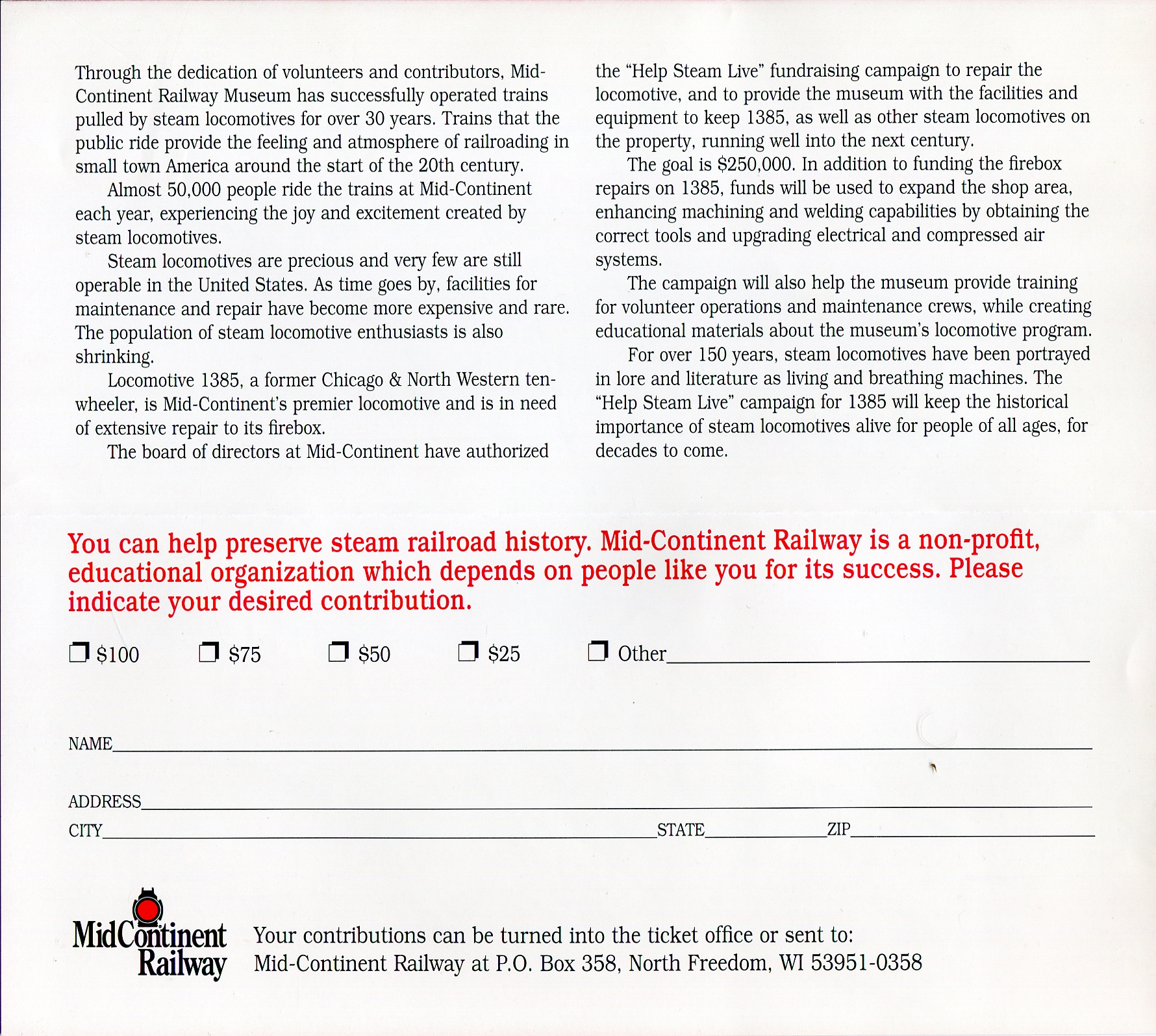
I was a member of the original campaign committee by virtue of being the new general manager, but my duties then did not include fund raising. That function was handled by a board member, who also functioned as the museum’s development director. He worked with an advertising agency we had on retainer and together they came up with the campaign title and fund raising strategy. This included the creation of a campaign brochure encouraging people to give in amounts strategically shown on the brochure in keeping with the accepted wisdom for how to elicit donations at the highest possible amount.

Inside panels of the HSL brochure

Inside panels of the HSL brochure


The campaign committee did everything according to Hoyle, if that erudite gentleman had been interested in donor development instead of laying out rules for gaming. Although gaming may be exactly what we were doing since after one year’s hard work of planning and preparation, the bank account holding our restricted donations for the Help Steam Live campaign represented less than 10% of the fund raising goal as compared to the 50% we had scheduled in our timeline. And with that dismal result, people were starting to disassociate themselves from what they viewed as another museum failure where fund raising was concerned. Being new, being naive and being frustratingly limited in the scope of my responsibilities as general manager, I asked the museum’s president if I could take over the campaign, which I did, in keeping with those guidelines I had witnessed in my prior work experience.

In due time we reached our goal. Hooray me! But let me now go back and stress that point about being naïve. We succeeded despite my ignorance. What I learned then, and there was plenty for me to learn, has guided all of my subsequent fund raising efforts. And here are a couple of takeaways I am glad to share free of charge to anyone who has found themselves in the terrifying position I was in twenty years ago.

Meeting notes increasing the scope of the campaign

Meeting notes increasing the scope of the campaign

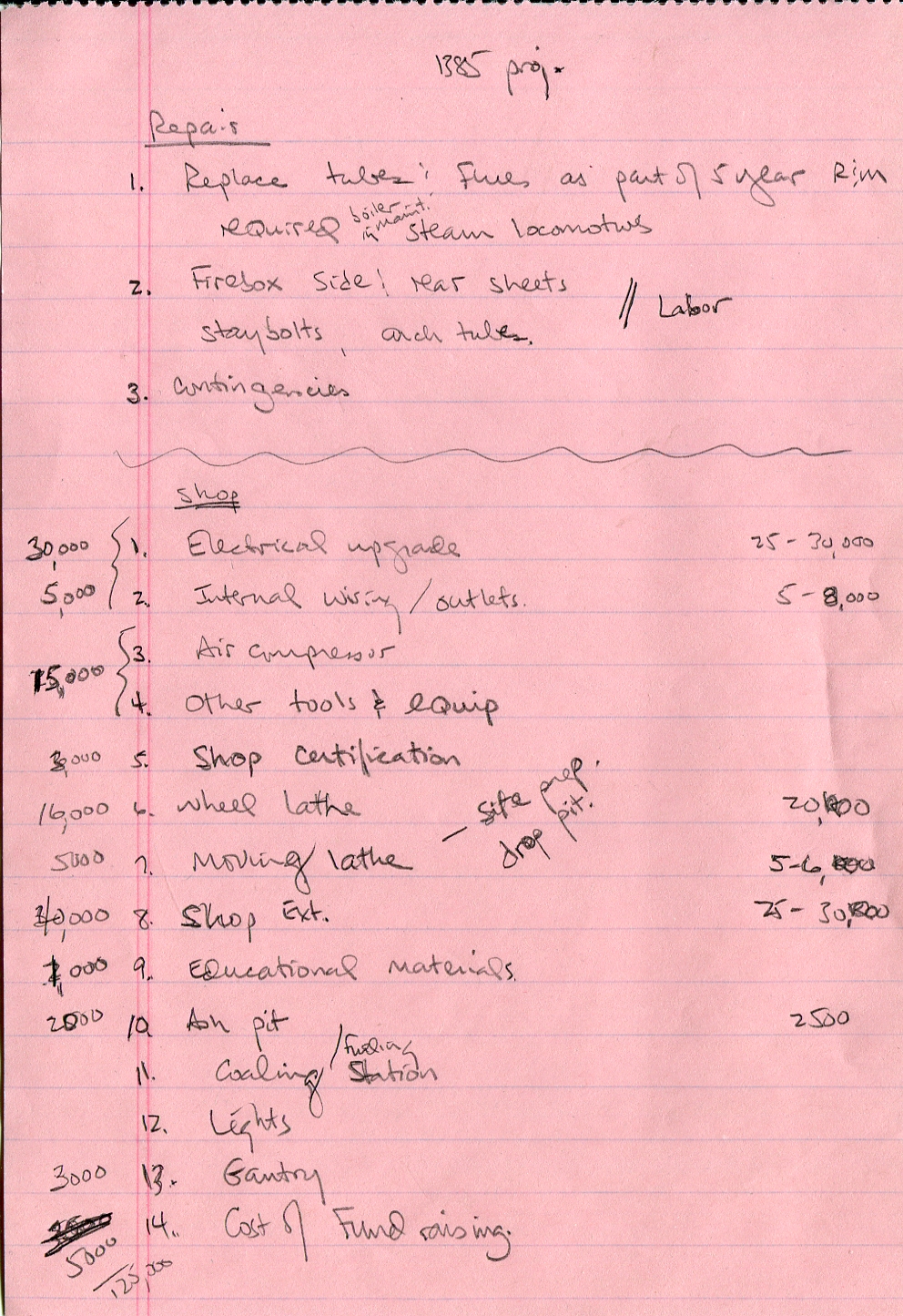
First, capital projects never cost what you think they will. They cost more, a whole lot more, which means the campaign goal will need to be higher as well, like it or not. The original fund raising goal for the Help Steam Live campaign was $100,000, which at the time was more than double the museum’s best year in fund raising. But it was not enough to do what needed to be done to return the steam locomotive to operating condition. I found that out after sitting through a few more meetings and even donning coveralls in order to climb in the locomotive’s firebox to get first-hand knowledge of the repairs the shop crew planned to make.

By the time I was done getting up close and personal with the mechanical beast the goal had increased to $250,000. This is the fund raising goal we attained. But even that proved to be insufficient once the work began and the hidden areas of a steam locomotive came to light, revealing damage that we did not know even existed. Hence a much revised and still in process restoration game plan.


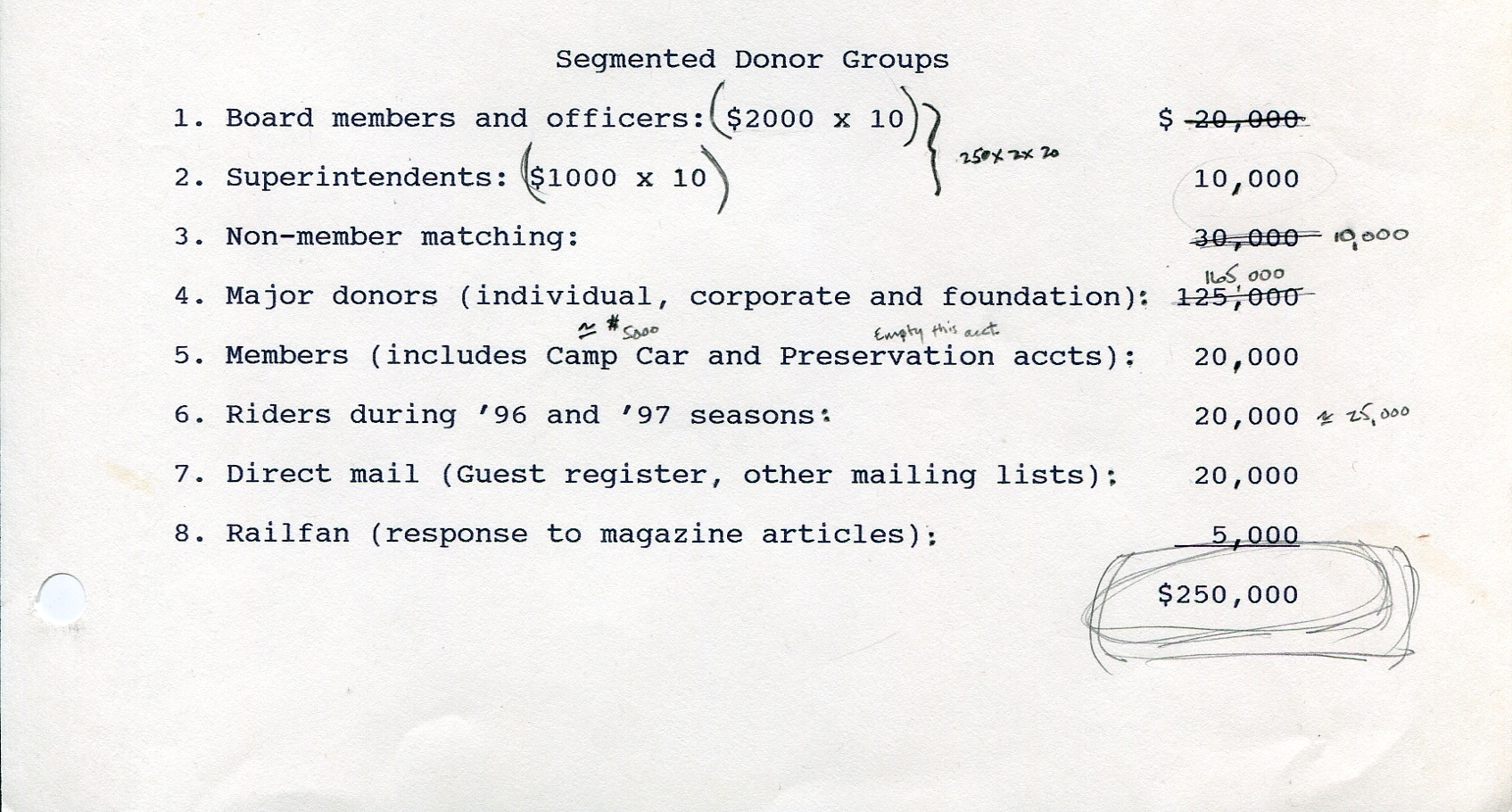
Second, the majority of the campaign gifts you receive will not come from the sources you so ardently planned for. I had dutifully researched the museum’s best potential sources of revenue and distributed to the board of directors a segmented list showing my best guess at the amount each segment would produce. It is shown here along with my penciled corrections after meeting with the directors, some of whom turned hostile and declined to seek re-election the following year. Their gripe: I was expecting them to “buy” their director’s seat by asking them to donate to the campaign. I have learned over the years that very few people who desire, even demand, to make decisions are willing to personally finance those decisions.

Proposed and amended giving tree

Proposed and amended giving tree


In last week’s meeting about the new building I took notes, asked questions, and bumped up the estimated cost of the capital campaign significantly. Fortunately another member of the committee was cognizant of the fact that as we talked we identified items not included in the purview of the contractors that still needed to be addressed and paid for by the museum. We’ll see if my guesses this late in my career show any signs of wise council in another, and perhaps my last, campaign.

A Moment in Time

Most of my management career has involved transportation of the nostalgic kind, typically as the general manager or executive director of a rail-themed museum. The proof is in my collection of prized achievements represented in this web site’s Archives page. They bear witness to the fact that my name and reputation is little known outside of that small enclave of enthusiasts, who attempt to preserve the heritage of America’s railways in their spare time.

There have been a few blessed departures from the norm that have allowed me to pursue my broader interests in history before returning to a more stable method of occupational therapy, aka a job, where I have made a reasonably decent living. One of these departures was the opportunity to devise a fund raising plan for the repair of the Frank Lloyd Wright designed Annunciation Greek Orthodox Church in Wauwatosa, WI. And this week’s message relies heavily on the case statement I prepared for its members in order to tell the story of my own fascination with a campaign to repair something of greater celebrity than anything I had ever worked on before.

My knowledge of Wright was limited and my awareness of the Greek Orthodox faith and the prominent facility Wright designed for this Milwaukee based congregation was even less. Fortunately a host of background material was readily available, most prominently in the form of John Gurda’s book New World Odyssey: Annunciation Greek Orthodox Church and Frank Lloyd Wright.

What I learned from this and other sources is that near the end of Wright’s career he accepted a commission to design a new worship facility for the members of this devout, ethnic community. It struck me as being an interesting collaboration between a man, whose vision and innovative talents transformed our perception of physical structures, and a people of faith, whose vision was for an internal transformation of heart and soul.
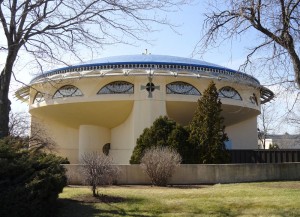
Wright's Annunciation Greek Orthodox Church

Wright’s Annunciation Greek Orthodox Church

Wright drew on elements of Greek orthodox history to conceive of a structure resembling a Byzantine church molded from modern Midwestern materials and placed in an affluent suburban landscape. But Wright did not live to see his vision take form. He died in 1959 prior to the groundbreaking ceremonies that launched the construction of this fabled building, which eventually gained the stature of other famous Wright designs by being listed on the National Register of Historic Places.
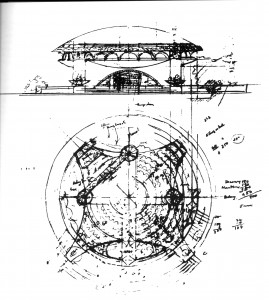
Conceptual designWesley Peters, the first apprentice Wright ever hired for his Taliesin Fellowship, took over as chief architect for the church project. John Ottenheimer, a fellow architect whose role at Taliesin included serving as the entity’s archivist, preserving all of the documents, plans and drawings created by Wright and his colleagues, served as the on-site architect to insure the faithful implementation of Wright’s vision. And it was directly from John that I was able to learn about the issues related to the building’s initial construction and the subsequent need to repair one of its signature features.

Wright’s design was essentially that of a circular structure with a domed roof. The section of exterior wall immediately below the roof was called the dome support band. It was to be comprised of 261 solid glass units set into the concrete wall. It was an attractive feature meant to allow the ambient light to filter into the church’s interior, but it proved not to be either feasible or affordable. Instead a hand blown, hollow glass alternative was manufactured and inserted into the wall between pairs of steel rods, installed to provide the necessary structural support.

At the time of construction the prevailing attitude among the Taliesin staff was that this type of fix would need to be corrected at a later date. This was affirmed in a 1974 report from Ottenheimer to Peters following a visual inspection of the facility. Clearly visible to him at that time was the accumulation of water inside some of the hollow glass spheres, for which he identified three causes: the extreme seasonal changes in the exterior temperature, the lack of proper humidity control inside the facility and the “… limitation of technology and budget at the time of construction.”
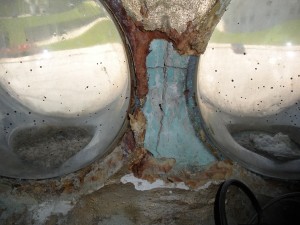
Corrosion between two glazing units

Corrosion between two glazing units

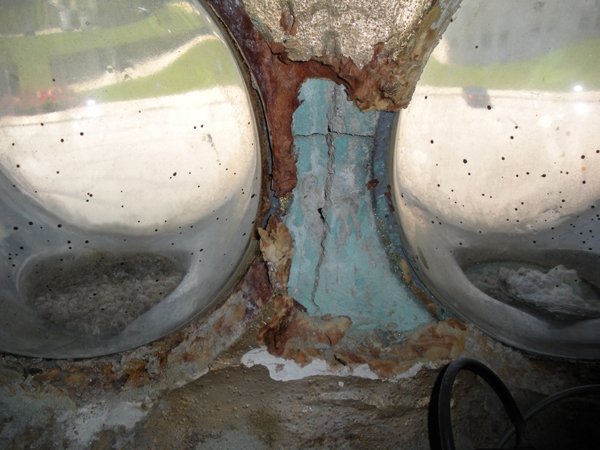
By the time I got involved another forty years had gone by and the need to take corrective action was even more apparent. Approximately 50 of the hollow glass spheres were noticeably cracked, trapping moisture inside the units, corroding the steel support rods and eroding the concrete walls.

Of all the principals from the Taliesin Fellowship who were involved in the construction of the church, John Ottenheimer was the sole survivor. His concern for the structure was still palpable during our conversations and e-mails. And it was during these exchanges that I learned about his passion for perfecting a viable solution that would also provide a desired continuity with Wright’s original vision.
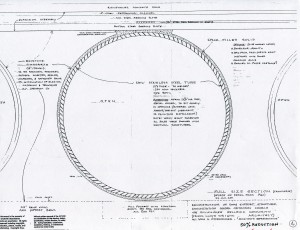
Ottenheimer's concept for a new glazing unit

Ottenheimer’s concept for a new glazing unit

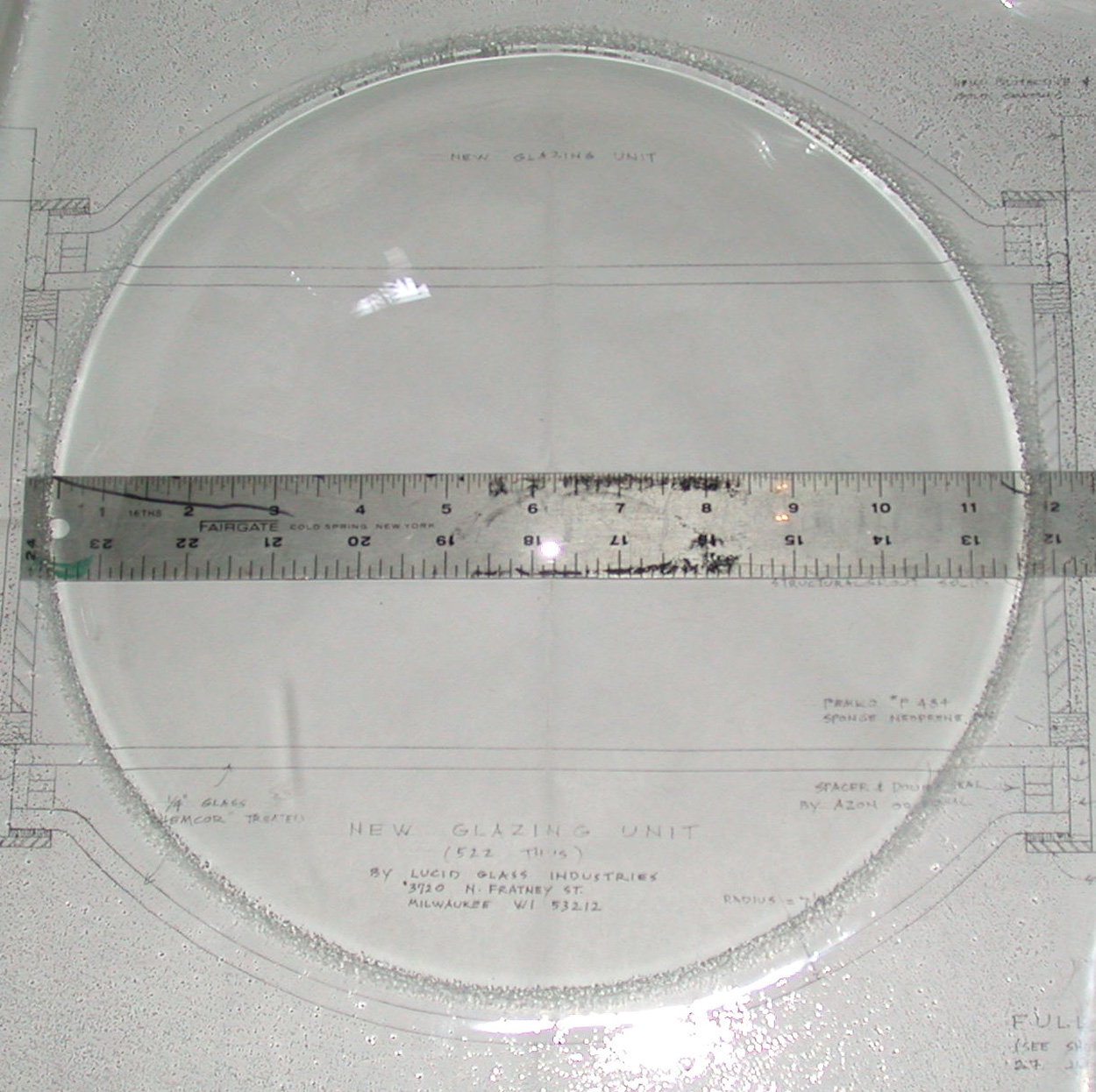
Ottenheimer’s proposed remedy was to replace all of the 261 hollow glass spheres with stainless steel cylinders, having the same 12” diameter and inserted into the gaps created as each sphere was removed. Convex glass lenses, capable of withstanding the seasonal changes in temperature, would then be affixed to each end of each steel tube forming a glazing unit, which, when properly sealed, would prevent further water damage from taking place. This innovative, though untested design, would also add strength to the dome support band should any of the original steel rods fail.
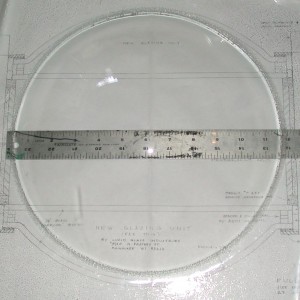
Sample lens manufactured by Lucid Glass to Ottenheimer's specifications.

Sample lens manufactured by Lucid Glass to Ottenheimer’s specifications.

Manufacturing the cylinders would be the easy part. The 522 lenses needed to cover both ends of the 261 cylinders in the dome support band would prove to be the most vexing part of the operation if it were to succeed. And the person on hand with the skills to craft these exquisite elements was someone who had proven her worth to me in a previous collaboration, the restoration of the Badger No. 2 fish-stocking railroad car for the Mid-Continent Railway Museum. Catherine Lottes, owner of Lucid Glass in Milwaukee, was highly experienced in the manufacture of specialty glass items and the plan was for her to create the prototypes for the lenses during a proof of concept phase, which would allow the design to be refined, if necessary, before production would begin on the remainder of the lenses.

The best estimate for the design, manufacture and installation of the completed glazing units was $550,000. I rounded this up to an even $600,000 based on my experience that the best laid plans of mice, architects and engineers always exceed budget. To raise such a sum was beyond the means of the small congregation alone and that meant opening up the fund raising campaign to encourage gifts from outside sources capable of making significant contributions. And this posed a different kind of problem.

People are reluctant to give to a religious organization for fear that their money will be used to promote a group’s sectarian doctrine. To mitigate this impression we set up a fund to be administered by the Greater Milwaukee Foundation for the singular purpose of paying for the building’s repair and maintenance. This step was intended to assure every donor, who wanted to repair and stabilize a Frank Lloyd Wright building, that the funds would remain independent of any religious programing. But it was important to me that the fund retain its identity with the Greek orthodox tradition and here is where my own creative instincts – or maybe cleverness – kicked in to merge the sacred with the profane to give the campaign its dual personality.

In classical Greek the word kairos was used to indicate a moment in time when a decision had to be made to insure an idea’s success. It was in fact considered to be the supreme moment for a person to act. And it was taught by the philosophers that a truly informed person “rarely misses the expedient course of action.” Similarly in the orthodox tradition there is a moment before the Divine Liturgy begins when a deacon whispers to the priest, Kairos tou poiesai to Kyrio, “It is the supreme moment for the Lord to act.”
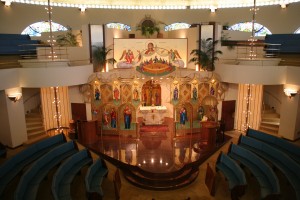
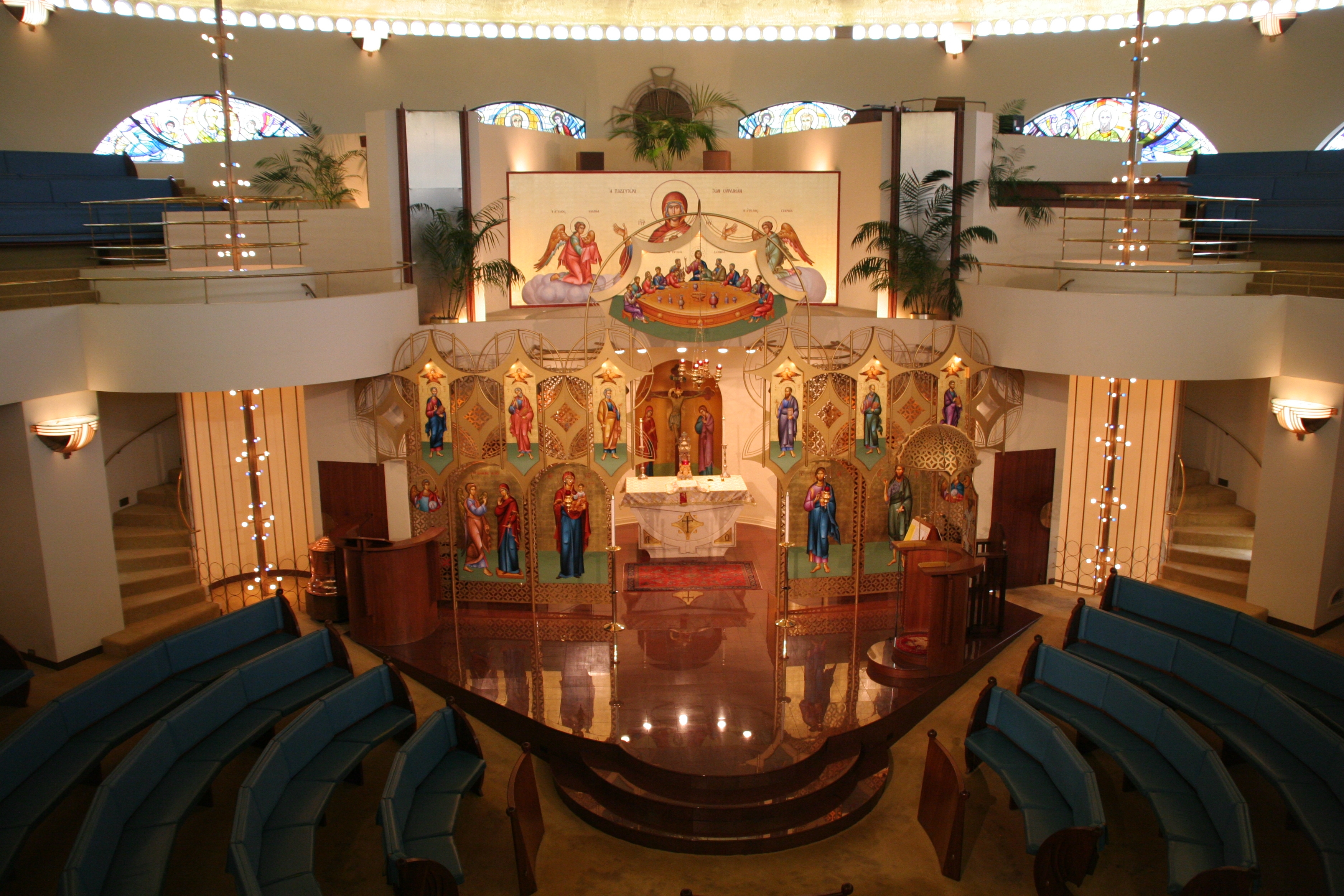
Church interior

Church interior

It was easy for me, then, to christen the fund being held by the Greater Milwaukee Foundation The Kairos Fund in recognition that this was to be the supreme moment to take action in order to protect the structural integrity of a building that united Frank Lloyd Wright’s vision with the sensitivities of the orthodox community. My hope was that people would perceive the Annunciation Greek Orthodox Church to be a place of worship as well as a cultural asset. Unfortunately, it was not to be. I failed to bring the most important step in this project to closure, the acceptance of the congregation to take on the full responsibility for the campaign’s ultimate success. And so my own supreme moment in time came to an inglorious end. The restoration of a 1907 steam locomotive awaited my willing though meager talents.

The whole episode did allow me to develop a better appreciation for the career that I have pursued in historic preservation by renewing my faith in why we do what we do. Spiritual values may be eternal but all physical structures, whether designed by the best architects or we mere mortals, are subject to deterioration and can only survive through proper care and the immediate remediation of serious defects. Wright’s celebrity was not enough to make his designs immune to the inevitability of decay with the result that of the 400-plus Wright designs that were actually constructed nearly one-fourth have subsequently been demolished, their brief moment in time all but forgotten.
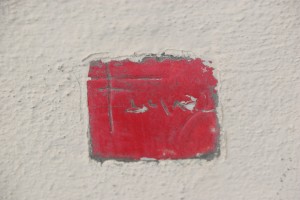
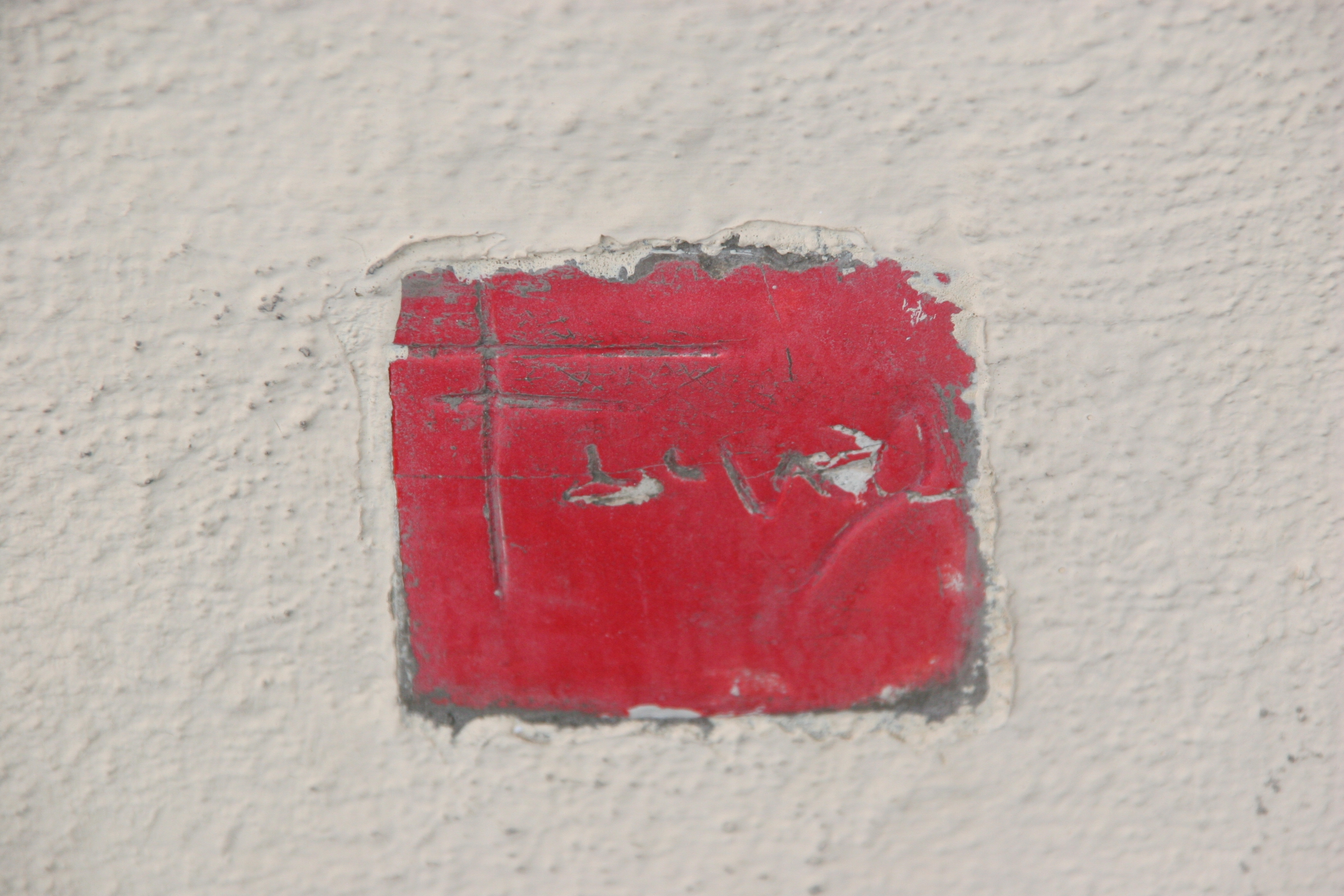
Wright's signature title embedded in wall

Wright’s signature title embedded in wall
On Fire for a Good Cause

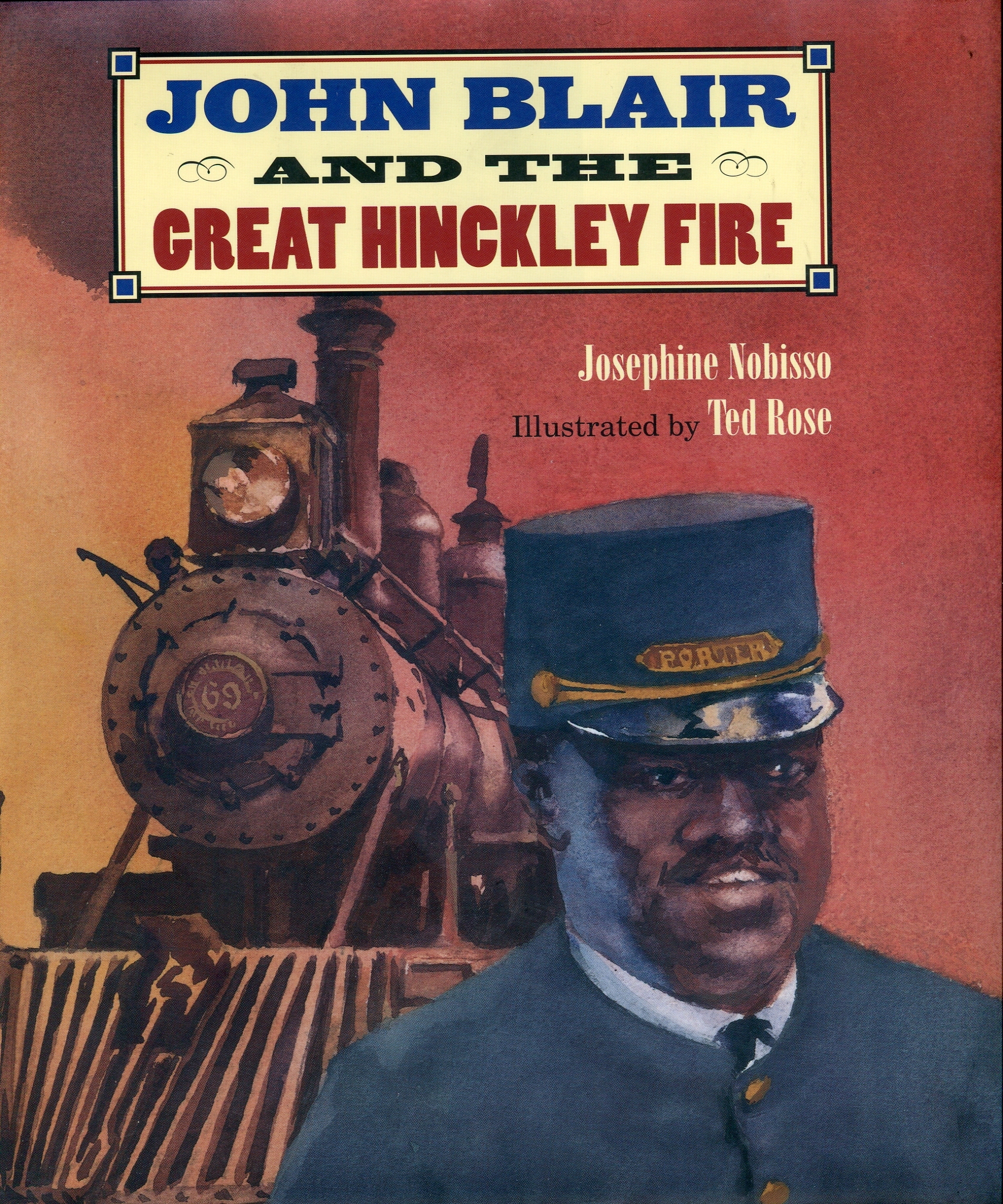
Sometimes you just get lucky. That is the only way I can explain one of those rare, unplanned opportunities, which help make a career a little more compelling than the humdrum routine of a manager’s daily life. My good fortune occurred during my tenure as the executive director for the Minnesota Transportation Museum. And it was because I had accepted that position the year before that I received a phone call in 2001 from an acquaintance of mine, a celebrated railroad artist, who wanted to donate some of his artwork to the museum.

John Blair 006

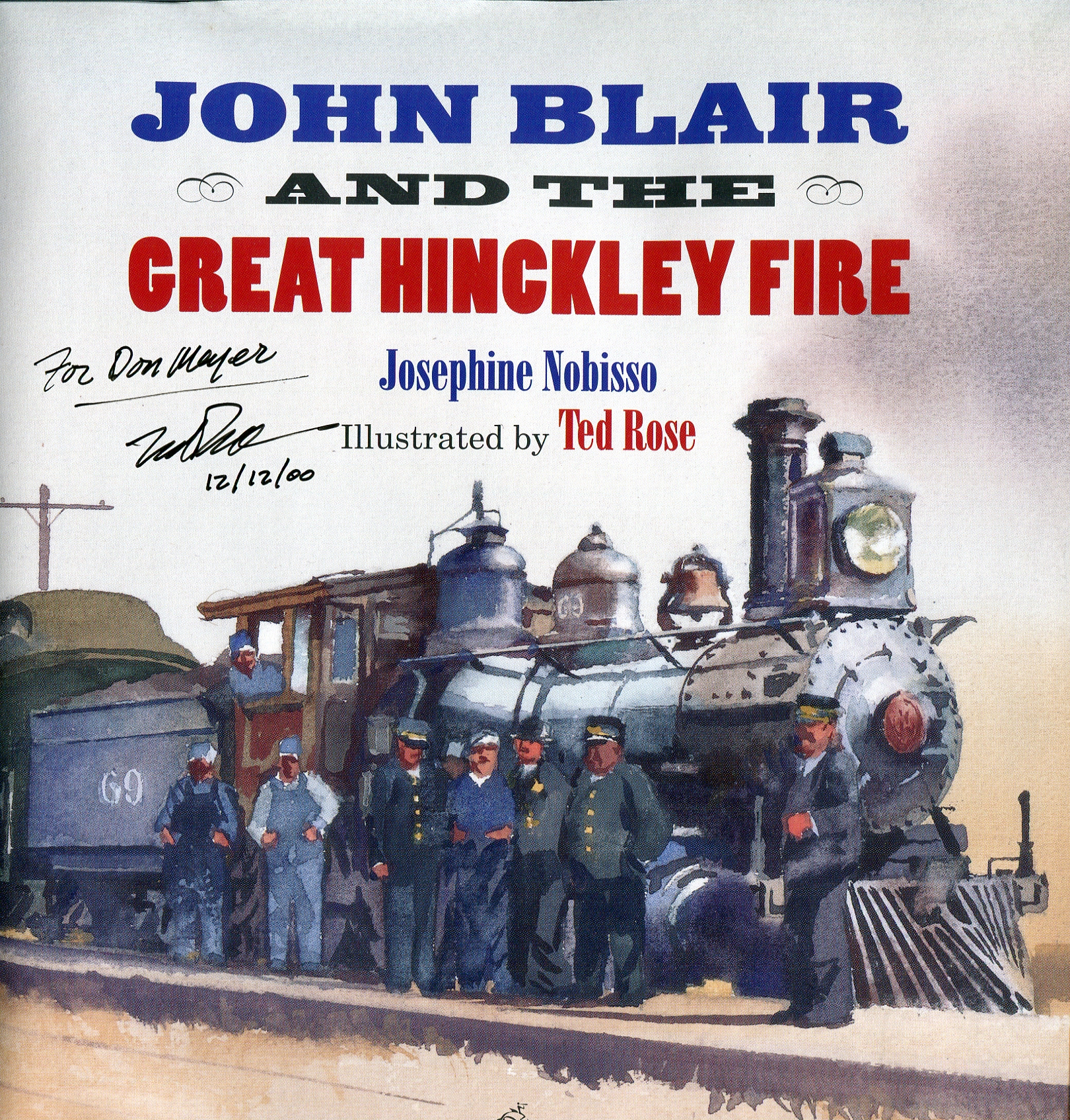
It was extremely easy for me to say yes without any hesitation even though I was initially confused about why the offer was being made. This call was, after all, from my favorite of all the then aspiring painters who drew their inspiration from rail related themes, and I wasn’t about to turn him away because of my own skepticism about his largesse.

You would have had to have known Ted Rose to understand my doubt. He was not an easy man to get along with and his reputation as an artist was not built on any glimmer of a charitable spirit. He was well known as a water colorist, had a large client list, and could be the crown prince of artistic curmudgeons when you said or did something he regarded as being lame or, even worse, stupid. Most important of all, he was not to be questioned when he made a suggestion about the display of his artwork. But I felt lucky, once again, to have the opportunity to run the risk of offending his visionary sensibilities.

John Blair 004The occasion was his recent creation of a series of paintings to illustrate a children’s book about a rather horrific and historic incident known as the Great Hinckley Fire. More specifically the focus of the story was the deeds of an African-American porter for the Saint Paul & Duluth Railway by the name of John Blair. The year was 1894 when a monstrous firestorm engulfed the region surrounding Hinckley, Minnesota, where the dry accumulation of debris from the logging industry provided the fuel that became the source for the devastating conflagration.

If you have never heard of this event, you are not alone. When Ted called to talk to me about it, I feigned a fabricated awareness in order to disguise my ignorance. I knew about the Chicago Fire that had decimated a fair amount of that city several years prior to Hinckley. But that was only due to the fact that it was the topic of a Tyrone Power movie I had once seen on television. And thus far the Great Hinckley Fire had failed to attract the attention of any Hollywood producers, directors or screenwriters, even though this particular catastrophe was of such epic proportions as to qualify as another Steven Spielberg blockbuster.


John Blair 002For me, however, the offer of the paintings proved to be the proverbial perfect storm for staging a museum exhibition in a museum lacking such rudimentary aspects of a truly cultural asset for the benefit of the local community. It combined the artwork of a prestigious contemporary painter, the compelling story of an important historic event for the region we were in, and the rare opportunity to showcase the positive role of African-Americans in early railroad operations. The importance of this last point was magnified by the location of MTM’s railroad museum, the former Great Northern roundhouse in St Paul. The location was strategically located to the north of what had once been the vibrant Rondo neighborhood, a black community that was obliterated to make way for I-94 to pass through the Twin Cities. We were about to make amends, however meager the result.

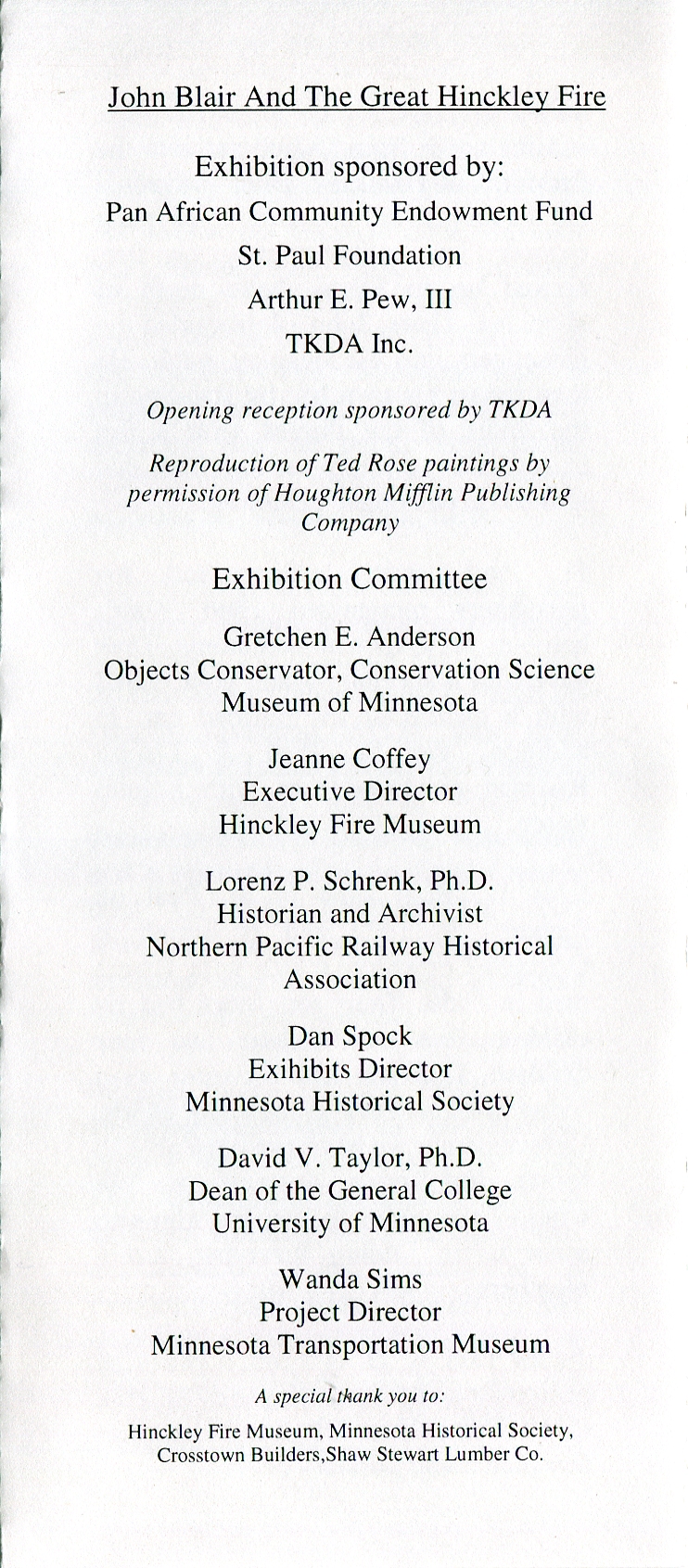
More elements that coalesced in this project to help make it a creditable experience was my acquaintance with a director for the Pan African Community Endowment Fund administered by the St Paul Foundation, who directed a fair portion of the Fund’s money towards the project as an exhibit sponsor. And I had a colleague on MTM’s staff who shared my passion for breaking out of the routine of our daily jobs to make something beautiful happen.

Much of the credit for the exhibition of the Ted Rose artwork illustrating the bravery of railroad porter John Blair goes to Wanda Sims. She was the project director for the renovation of the Great Northern roundhouse into a viable museum destination and welcomed the chance to help put something inside the structure that would lend credibility to the claim that this was, indeed, a history museum. It was through her contacts that we were able to assemble the rest of the financial backing needed to cover the cost of the exhibit and the opening reception. And together we enticed the participation of knowledgeable people from other museums, historical societies and the University of Minnesota to serve on our exhibition committee, allowing a business manager and a construction superintendent to make use of others’ expertise in achieving what we were not exactly trained to do.

John Blair 003

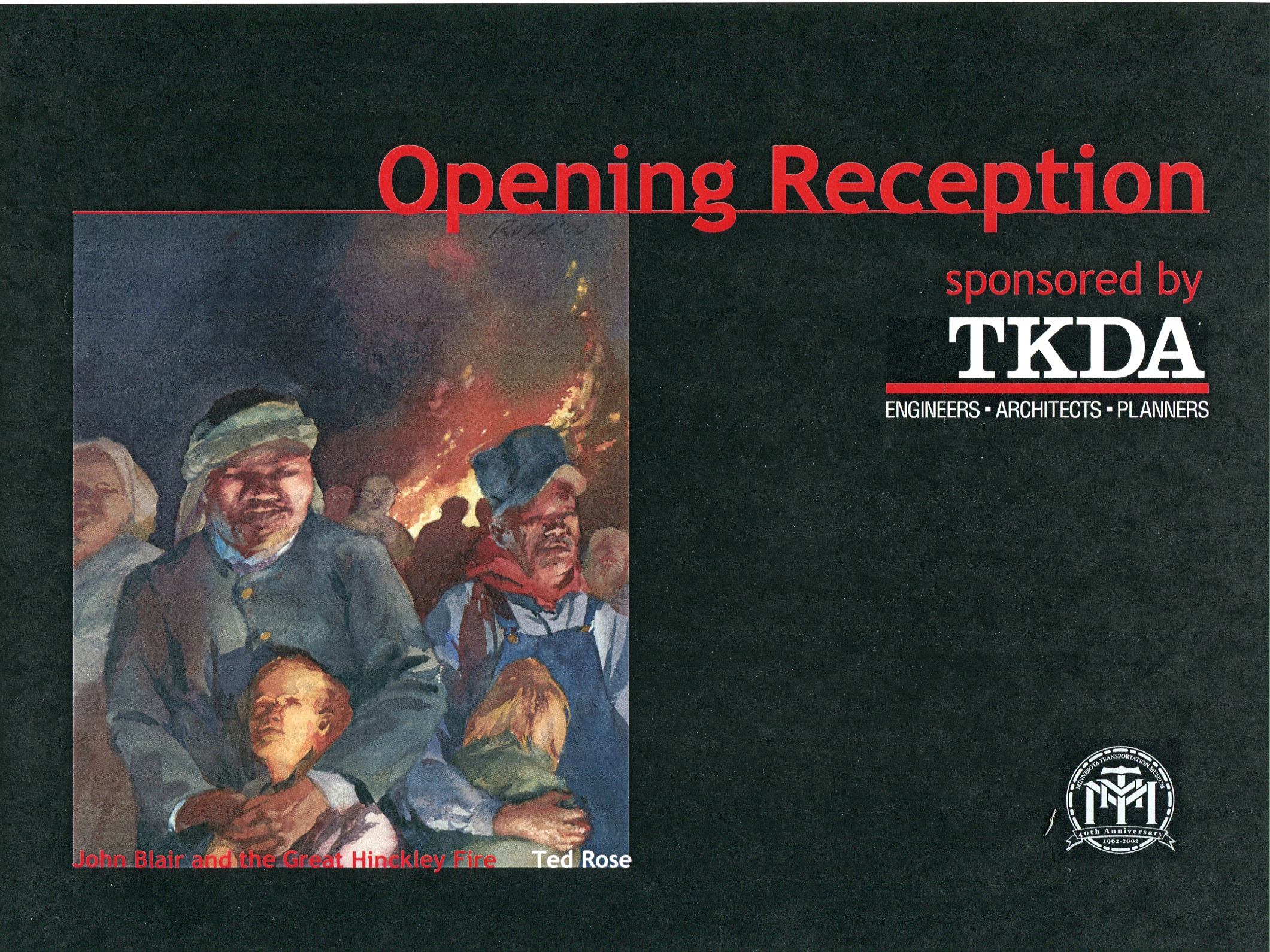
The opening reception was by invitation only, consisting of a guest list that included in equal parts prospective donors I had been courting during my brief tenure as MTM’s executive director and donors to the Pan African Community Endowment Fund. Most of these folks had never set foot on any of the MTM properties. This was a groundbreaking experience for me as well as the organization I served, which puts me in mind of a comment I almost made when asked by an MTM board member during our preparations what kind of people would be attending the reception. I thwarted my cynical self’s ambition to say “black people” and opted for the more benign reference to “people of substance.” But in truth, when the doors to the roundhouse opened to welcome our guests to a most elegant setting inside an industrial structure, I was pleased to see the mixed ethnic composition and gloated (internally) at the compliments we received for the statement we were making about our role in bringing to light a hidden gem of railroad history, the powerful contribution of the African-American community.

The one sad note to this whole episode was the inability of Ted Rose to attend and share in the accolades of this wonderful event his gift generated. I was to learn a short time later through a mutual friend that Ted was dying of cancer. And the following year he was gone.

Ted was an obstinately unique fellow. He found beauty in industrial landscapes, favored the railroads whose imagery and history we both sought to popularize with the general public, and eschewed any attempt by anyone at fawning admiration of his talents. He remains my favorite railroad artist and I would encourage anyone who is curious about sampling some of his work to search the internet for Ted Rose artist. There you may get a glimpse of the genius behind the ornery personality that helped infuse my career with a moment of glory as sonorous as the colors of his artistic palette.

John Blair 005

You Are Cordially Invited

New Year’s Day! It is time for me to start thinking! And to help me break out of the lethargy of both the long holiday season and my avoidance of writing any new web log messages, I am resolved to start anew by launching into a series, which may tax my memory a bit, but still provide me with sufficient material to get me through the rest of the winter.

I am in the process of cleaning out my office files and have been delighted to re-discover some of the ephemera I have hoarded over the years, thinking that my projects had value. Today they do as they will prove to be the source of my inspiration to write about deeds done and the results of my labors. It will also allow me to enhance this website’s archives page as each of the projects I write about will be listed there in recognition that a manager can do more than pay bills and files financial reports no one will ever read.

Invitation's Front Panel

Invitation’s Front Panel

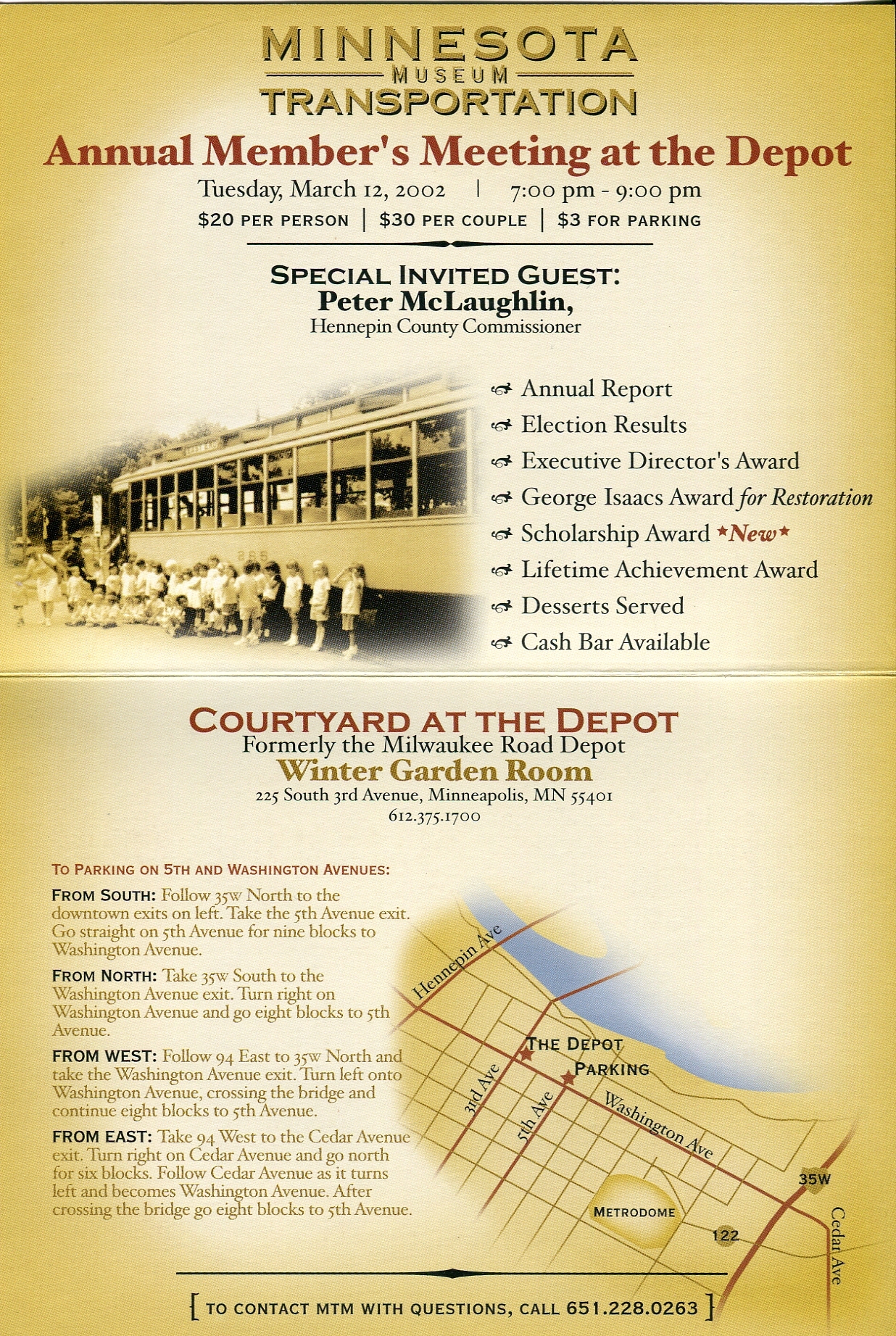
So you are cordially invited to join me, appropriately enough, with this first message in the series describing the creation of an invitation to the 2002 members’ meeting for the Minnesota Transportation Museum. At the time MTM was an amalgamation of disparate transportation sites recreating historic travel aboard streetcars, a steam boat, buses, and trains. I had been MTM’s executive director for a little more than a year and was trying desperately to create a unified organization covering five sites spread out over a hundred mile stretch from Lake Minnetonka in the west to Osceola, WI in the east.


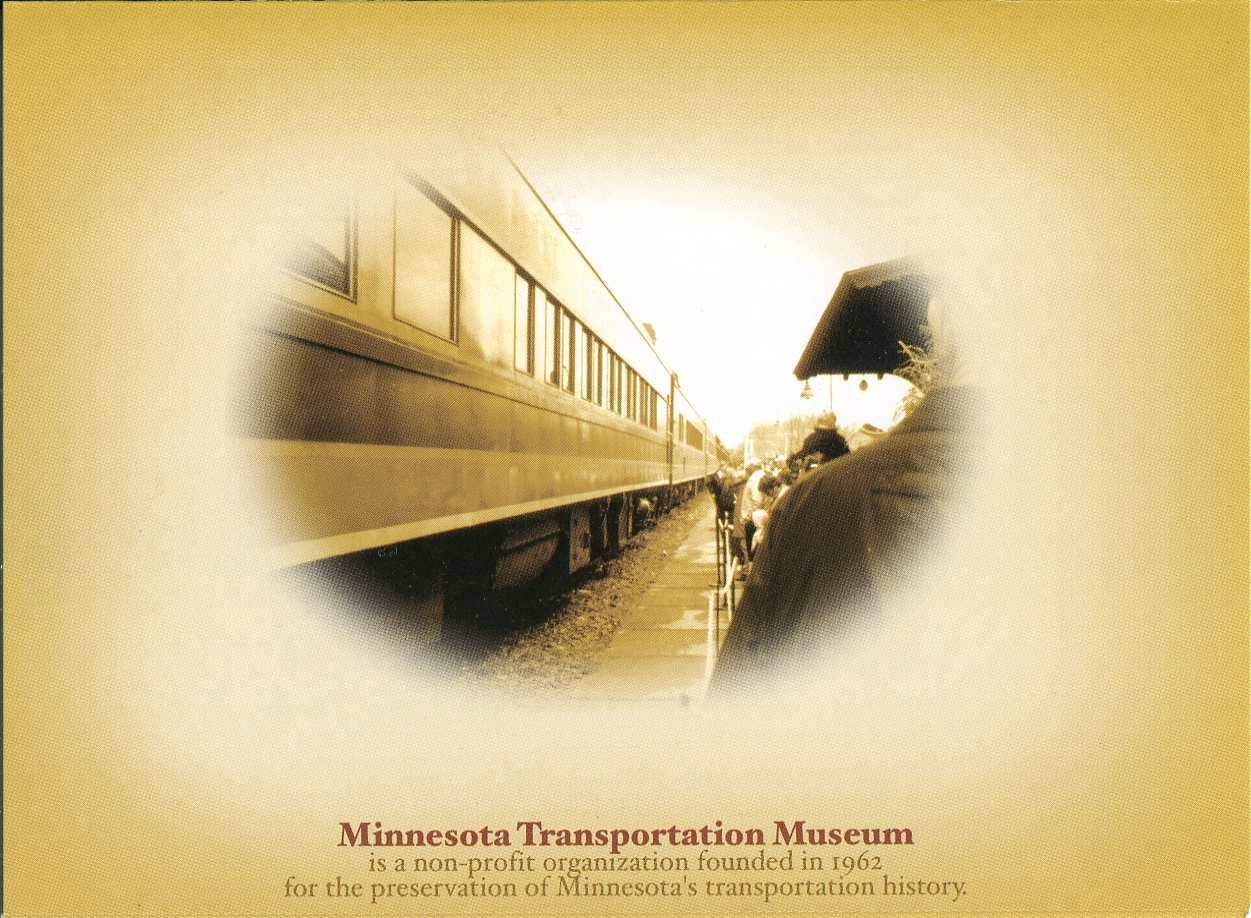
Invitation's Back Panel

Invitation’s Back Panel

MTM was divided into operating divisions with the derivative word divisive being an apt term to apply to how they functioned, or failed to do so, as a supposedly single entity. Except for the accounting system, everything else was decentralized to the point of being grossly inefficient and ineffective, especially when it came to marketing and fund raising, things that I was hired to improve. One of my first projects to help overcome the problem was to create a single promotional brochure, which will be described in a future message in this series. Another was an attempt to restructure the annual members’ meeting; a poorly attended, unimaginative affair that will be forever associated in my mind with my predecessors serving wine in a box as an attempt at class.


MTM Invitation 005I am a strong proponent of finding something new to offer any audience. And for the members of MTM the something new involved three things – location, program and the all-important food service.

Location was the easiest of the three criteria to fulfill. The former Milwaukee Road depot in downtown Minneapolis had recently been renovated as part of a hotel/conference center. It fit my heart’s desire to find a place that had cultural significance along with a transportation affiliation. The Courtyard at the Depot was a perfect fit for this and for its tie-in with the program.

You can see on the invitation that our special guest speaker was Hennepin County commissioner Peter McLaughlin. And that night he unveiled the initial plans for MTM to participate in the development of a new museum in cooperation with the county to repurpose the former monolithic Sears Building on the city’s south side into a transportation hub – another future web log message. The program also contained other elements I think are important for a volunteer-driven, non-profit corporation; accountability in the form if a (brief) financial report and the bestowal of awards celebrating the work of the member/volunteers in order to boost morale, celebrate examples of what we want from our volunteers and to encourage further participation by knowing that you may someday be publicly acknowledged for your efforts.

I wanted the food service to be just as special as the choice of location and the surprise elements of the program with its awards and the announcement of a new initiative. To do this and to keep the cost manageable we held the meeting after the dinner hour, allowing us to offer specialty desserts as opposed to a full meal. And since MTM was too poor to cover any of the costs from its general fund you can see that there was a price for admission and we replaced the ubiquitous wine in a box with a cash bar.

Requiring members to pay to attend had one other benefit that I will admit to all these years later. It prevented a certain element within the membership from attending, comprised of those folks who thought their meager membership dues entitled them to enjoy everything museum related for free. But not that night. The quality of the event was matched by the quality of those who attended, whether they be members, staff or invited guests. The camaraderie reached across divisional lines and for a brief moment I thought I was looking at a new era in the history of the organization. But that was not to be, which is another story for me to tell another time.

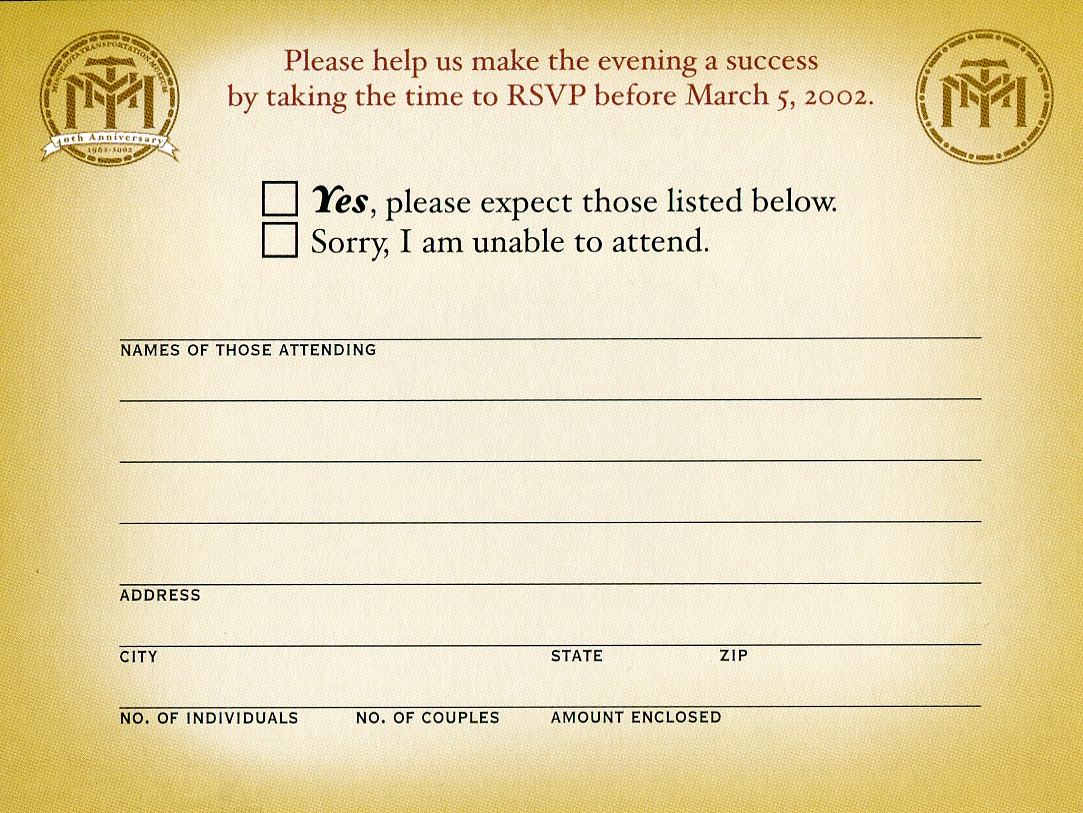
Response Card Front Panel

Response Card
Front Panel

Turning my attention back to the invitation, here are a few more tidbits that went into its design in order to create an attractive piece and avoid some of the major pitfalls inherent in a dysfunctional organization. There was a lot of pertinent information to convey in a small space, which we achieved without losing a pleasing presentation to attract the eye to the extensive content. The colors chosen were representative of the colors found on the historic equipment that served as icons of the MTM operation, but toned down in such a fashion as to express warmth intended to enhance the concept of this being an invitation worth responding to.


Response Card Back Panel

Response Card
Back Panel

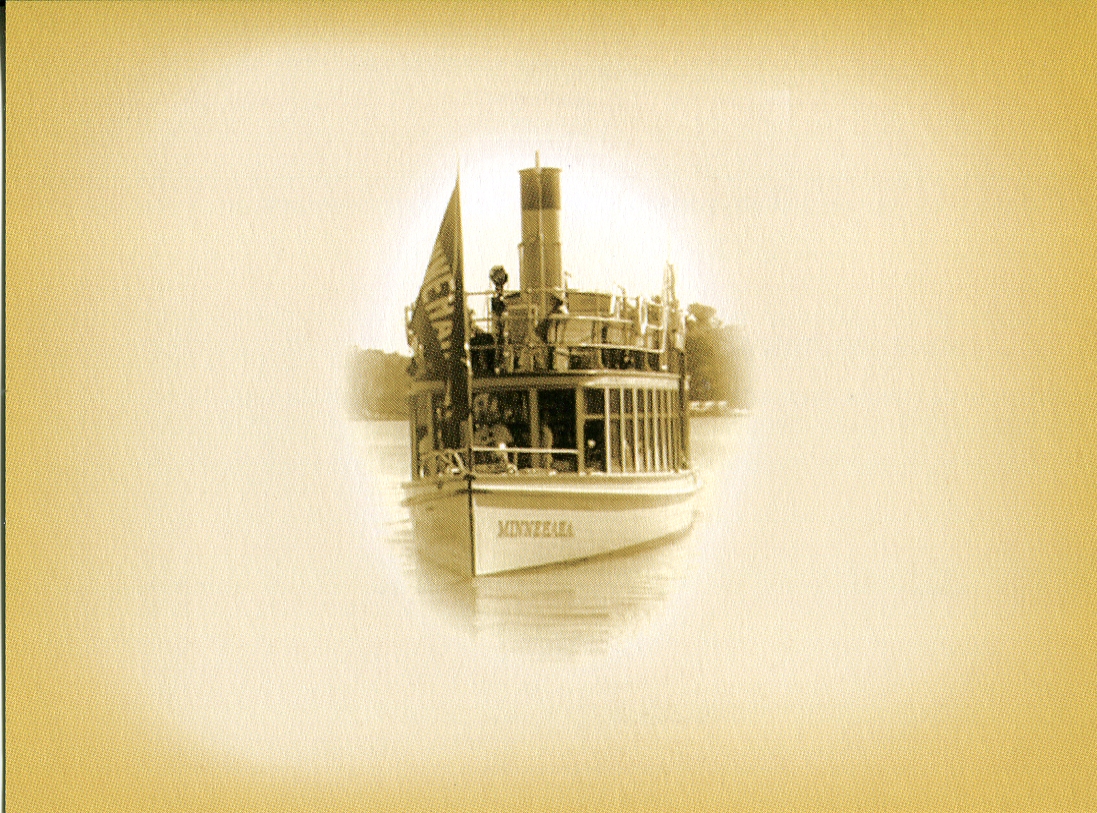
You will also see that on the upper inside panel of the invitation we used the image of a streetcar at the Como-Harriet station, on the back panel we used a scene from the train ride at Osceola, and on the back panel of the response card we pictured the steamboat Minnehaha cruising the waters of Lake Minnetonka. It was extremely important that we feature all three of these pre-eminent operating divisions within MTM so that no one appeared to be favored over another. That is one of the challenges of trying to bring unity out of disparity. Equitability must appear to be effortless, but I never found this unappreciated, highly valuable aspect of management to be so. It comes with its own price and no cash bar.

A Special Edition Gazette

Gaz cover 1983 issue 001

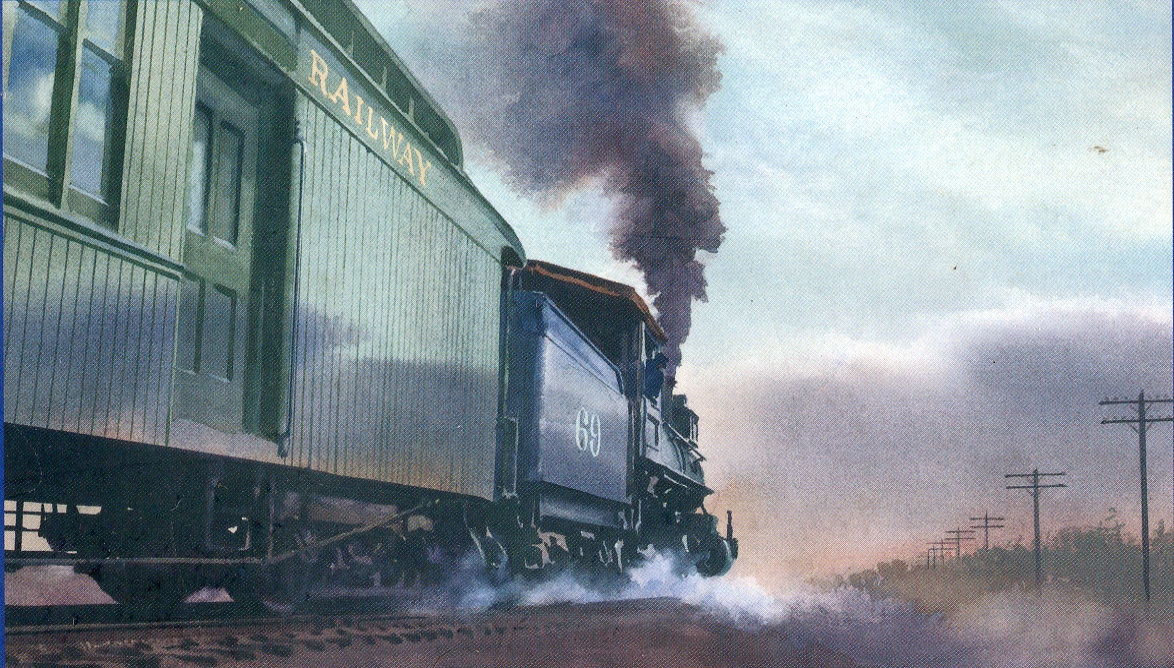
This week’s message comes with an illustration, a scan of the front cover of the latest edition of the Railway Gazette. I mentioned this issue briefly at the end of last week’s message in conjunction with the open house at Spec Machine, where people could learn about the work taking place on the running gear of the former Chicago & North Western steam locomotive No. 1385. Now I want to make the magazine the feature of what I have to say this week in order to express my thoughts on what it represents as part of that campaign.

The decision was made at the start of the fund raising campaign for the locomotive’s restoration to make sure some news item appeared in each issue of the magazine related to this project. This allowed us to keep the project a current topic of interest, especially as we were encouraging people to donate to help us meet a $250,000 challenge grant offered by the Wagner Foundation. But it also allowed me to fulfill a second and longer standing goal, that of using the December issue as a special, expanded edition focused on a single topic.

These special editions have always been something of a challenge to complete. The emphasis on the depth and length of the content required us to find someone, whose personal research met our need. That person also had to have some ability, let alone the discipline, to write about a topic based on research that was little more than a hobby for them. Our own history with No. 1385 and the museum’s archives provided us with the materials needed to meet this challenge. And it allowed me the opportunity to exercise my own latent gifts by being both writer and editor of the text.

Without asking permission of anyone, I used my access key to the museum’s office and in a covert operation removed the 1385’s files from the archives. Having them safely stored at my home office made the research part of the process a little easier to perform. And the materials were always on hand during these early morning writing sessions, which characterize my work. Since my childhood days, afternoons have been meant for play. The serious takes place before 10:00am.

The special edition Gazette we did in 2011 was a fairly singular effort. The content was based almost solely on what I could find in the archives, offering a broad overview of the locomotive’s history since its purchase for the museum. I quoted heavily from prior issues of the magazine and scanned previously published images as our only means of illustrating the text. But it led us to a follow-up article by one of the original engine crew members, who operated No. 1385 during Mid-Continent’s first year (1963) at its new home in North Freedom. It was gratifying to have some participation from a person who had hands-on experience with the locomotive during those early days.

Interim Gazette issues reported on work taking place with No. 1385’s tender and cab. The next special edition of the magazine again relied heavily on the museum’s archives to tell the story of how the locomotive came into pre-eminence as Mid-Continent’s star performer after seeing very little service since its 1963 debut. The article revealed the back story that led to the locomotive’s involvement with the Prosperity Special, a public relations event staged by the Chicago & North Western Railroad. The plan was to use one of its former steam locomotives (No. 1385 being the only one functional) to pull its modern equipment to destinations along its rail network as a means to showcase the company’s impact on the economies of those communities.

This was 1982 and the plan worked well enough that the powers that be at the North Western asked if they could also take No. 1385 to Boone, Iowa that same year as part of the town’s celebration known as Pufferbilly Days. At each location the steam locomotive was the principal draw and it inspired the North Western’s officials to negotiate further with the museum’s leaders to allow them to run No. 1385 the following year on a much expanded tour over a larger part of its system. The locomotive subsequently became the gem of the museum’s collection and Trains Magazine dubbed Mid-Continent the “Midwest Ambassador of Steam”.

For our more immediate purposes the special edition about those first excursions in 1982 produced an unsolicited photo essay by another one of Mid-Continent’s members, who happened to take photographs of the locomotive during one of its moves on the North Western. This gave us our first opportunity to published previously unseen images relevant to the story we were trying to tell. It also sent a subtle message that, yes, we would like to have others help us tell the story in order to generate more enthusiasm for the campaign.

Fast forward to this most recent special edition Gazette reporting on the excursions which took place in 1983. Once again the museum’s archives were the primary source of information with regards to correspondence and newspaper articles. But there is a dearth of photographs to be had amongst these documents. Fortunately the word was out about the intended topic and Mid-Continent members came forward with those rail fan pictures they took when they chased the train along portions of its well publicized route.

This type of buy-in by those who wish to participate in telling No. 1385’s story is a much welcomed addition to our efforts. The open house at Spec Machine, reported on in last week’s message, is another example of the desire by others to help promote the project. If you visit the museum this summer you will see new displays in the depot which support this campaign with more history and images about the North Western and its steam fleet. And there is an enhanced web page easily accessible on Mid-Continent’s web site which provides current updates about the restoration work taking place on No. 1385, now focused on the work taking place at Spec.

The growing sophistication of the campaign to restore the locomotive mirrors the expanded use of No. 1385 during the glory years of the 1980s when it could be seen in operation over ever increasing miles on the North Western’s system. The locomotive became the image of Mid-Continent. The number of people engaged in staging these events can only be described as innumerable. And the attendance at Mid-Continent’s North Freedom venue increased.

Growth is imperative for any operation that wants to stay in business. And for me the content of this special edition of the Gazette offers the evidence that growth is taking place once again as measured by the number of people involved in the program, the extended reach of the message, and the subsequent financial benefit we see through an increase in the number of donors contributing to the campaign and the size of their gifts.

We are a long way from seeing a completed steam locomotive in operation at North Freedom. The running gear work alone is estimated to require another two years worth of full time work. But progress is being made and the collateral benefits are being seen as we continue to promote the campaign to restore this valuable relic listed on the National and State Registers of Historic Places.

If you are not a Mid-Continent member but would like to obtain a copy of this issue of the Gazette, you can purchase them by calling the museum’s office at 608-669-1385.