Author Archives: Don Meyer

About Don Meyer

Retired non-profit administrator

Temperance

I am working my way through the book, On Reading Well, to explore the concept of virtue. This is not exactly the author’s intent for her readers as the book’s title indicates. Professor Karen Swallow Prior does want us to read well by suggesting a few guidelines for helping us delve deeper into the form and content of a book as a means to enhance what people often refer to today as our emotional intelligence.

Key to Professor Prior’s methodology are four concepts to help us plumb the depths of any literary work by 1) reading a wide array of literature (what she calls reading promiscuously),  2) reading slowly as opposed to being a casual reader, 3) underlining and making marginal notes to help underscore vital points in storyline and character development, and 4) reading virtuously. It is this latter concept, which fundamentally shapes the format for the rest of her book.

Professor Prior looks at twelve literary works to show us how each one illustrates specific virtuous traits in keeping with those historically identified by philosophers and theologians as essential for personal and social wellbeing. For Aristotle this meant the attainment of the ultimate purpose for one’s life, happiness.

The first section of the book examines the four cardinal virtues, which the Greek philosopher Plato proclaimed as foundational in each citizen for sustaining the viability of any society. The four include prudence, temperance, justice and courage.

Last week’s message was my response to how Professor Prior used Henry Fielding’s 1749 novel, The History of Tom Jones, a Foundling, to teach about the virtue of prudence. This week the pairing is F Scott Fitzgerald’s 1925 novel, The Great Gatsby, to discourse on the virtue of temperance.

The Latin word temperantia was used by Cicero to translate Plato’s use of the Greek word sophrosyne, which may be more appropriately translated into English as moderation. To be temperate is to moderate our behavior, traditionally applied to our basic appetite for food, drink, and sex. But the character of Jay Gatsby shows us that intemperance is not limited to how we indulge our cravings for these three things. The accumulation of material possessions in an ostentatious display of wealth is an outward manifestation of an intemperate spirit.

Gatsby’s demonstration of conspicuous consumption emanates from his pursuit of a former lover. His obsession propels him to acquire great wealth – as evidenced by his mansion, lavish parties and pricey clothes – to entice the fickle Daisy back into his life. It doesn’t work, but that is the only spoiler you’ll get from me in this message. Read the book or watch one of the cinematic attempts to tell this story within the allotted running time of a movie to learn of Gatsby’s fate.

I will tell you is that what Jay Gatsby and Tom Jones have in common is that neither one is the exemplar of their respective virtues under consideration. We learn about temperance in Gatsby and prudence in Jones by what’s missing from their lives. The lesson, if any, seems to come from a sense of loss for what might have been had they behaved differently, as in virtuously.

It is hard to find a prominent literary character, who personifies temperance (or prudence for that matter). In my reading experience the virtue of being temperate seems to be left to supportive female characters, such as Bronwen in Richard Llewellyn’s 1939 novel How Green Was My Family or Mary Vertrees in Booth Tarkington’s 1915 novel The Turmoil. Further, it seems to me, that the gift of temperance revealed in these women is reflected as much in their physical appearance as in their behavior. Both are beautiful but not glamorous, poised without being rigid, graceful in their movements, slender, soft spoken, arresting though modestly dressed and present without being domineering.

Consider Tarkington’s description of Mary Vertrees as he hints of her internal qualities through the simple act of watching her play a piano. He writes, “There is no gracefulness like that of a graceful woman at a grand piano. There is a swimming loveliness of line that seems to merge with the running of the sound, and you seem, as you watch her, to see what you are hearing and to hear what you are seeing.”

We typically refer to the lack of temperance or moderation in a person’s appetites as the need for self-control. But such a banal analysis ignores what is truly at work in the individual, whose behavior craves some satiation in the form of food, drink, sex or (like Gatsby) acquisitions. At stake is the suppression of feelings; food, drink, sex and possessions becoming the narcotic for sedating an awareness of our own emptiness.

My idea of a temperate person is expressed in the words written by the Apostle Paul in a letter addressed to a small fellowship of Christians in (appropriately enough) the Greek city of Philippi. He told them of his own experience with living a life of moderation by saying;

“I know what it is to be in need, and I know what it is to have plenty. I have learned the secret of being content in any and every situation, whether well fed or hungry, whether living in plenty or in want.” Philippians 4:12

Contentment: it is the hallmark of a temperate person.
Prudence

A few weeks ago I committed myself to a series, perhaps unwisely, on examining various aspects of virtue. To say the choice lacks wisdom is ironic since such a topic requires a great dose of wisdom in order to comprehend and write about it, even casually, with some sense of meaning.

The thought that I could do it was based on the use of a certain intellectual crutch by following a path of investigation already established by Karen Swallow Prior, a professor of English at Liberty University. The crutch is her book, On Reading Well, which provides an analysis of twelve virtuous traits, identifying their classic definition and illustrating how we can experience them in literature instead of sitting at the feet of some modern day Socrates, Plato or Aristotle.

Chapter one deals with prudence, considered by many to be the queen of virtues. And here I need to stop long enough to make an editorial announcement about the use of gender specific terms in this series. The ancients portrayed virtue as female. Professor Prior retains that imagery. But anyone who needs to see the world as non-binary can do the reconstruction of my writing in their heads since I will, for the sake of ease, follow the good professor’s means of expression – to a point.  If I differ at all, it will be because I define things a little differently based on my own profession as an administrator of modest commercial success in a very competitive marketplace. For example:

Professor Prior writes: “Virtue requires judgment, and judgment requires prudence.” I am reluctant to use the word “judgment” since its fullest implication leads to condemnation, which leads to punishment. My revision of her sentence would simply substitute a word like “decisions” for “judgment” and then stress that an effective decision making ability requires prudence and courage (another virtue to be discussed in this series).

It’s not just the good professor with whom I respectfully disagree. She quotes the venerable Cicero, who defined prudence as “… the knowledge of things to be sought, and those to be shunned.” My own take on this is that prudence is mental action, reasoning, whereas Cicero seems to imply that prudence is simply a repository of acceptable behaviors. If so he reflects Solomon’s endless catalogue of proverbs to be recited at the appropriate moment to characterize a person or event.

We acquire knowledge throughout our lives. Prudence, to my way of thinking, is the ability to correctly apply that knowledge to the ever changing array of circumstances we encounter in order to choose the most favorable outcome. It is decision making on the fly.

I think this does bring me into harmony with the ancient belief that prudence is the application of practical wisdom as opposed to the more erudite concept of wisdom as the purveyor of sophisticated abstract reasoning, what the Greeks called sophia. Prudence, derived from the Latin word prudentia, which implies the ability to foresee outcomes, by comparison is a type of wisdom accessible to all despite the relative merits of our intellectual prowess.

The structure of Professor Prior’s book is to illustrate her concept of each virtue under consideration with a highly regarded work of literature. For the subject of prudence, she chose The History of Tom Jones, a Foundling, by Henry Fielding. This puts me at a disadvantage since I have never read the book. So to compensate for my literary deficiency I consulted Wikipedia, the Cliff Notes of the internet, to learn more about the storyline and its characters. This, however, only added to my confusion about the choice of this book about a kind-hearted, well-meaning profligate to enhance our awareness of the virtue of prudence. It is well within the professor’s stated premise that we can learn virtue from others whose behavior is the opposite of the moral ideal. But I must confess that it works better for me to see a positive example of how life is to be lived than to parse the failings of a negative example, as represented in today’s anti-hero model.

Here, then, is my own literary offering for an example of prudence. It is to be found in a simple sentence from a story, whose popularity is based more on the amended movie version than the book.

“There were many bosques, or thickets, now and he detoured them.”

A tinhorn from the East would not understand the need to avoid a bosque in 1901 Texas just outside the border town of El Paso. Such a natural barrier forms a much favored place for a robber to hide intent on ambushing a road weary traveler. The “he” in this sentence, who is prudent enough to avoid these potential hazards, is J. B. Books, The Shootist of the eponymous novel written by Glendon Swarthout.

To be certain there is no morality here. Just survival. A prudent man uses his knowledge of the land and the times to avoid danger. But without a moral purpose, we tend to call his actions crafty or canny. There are other examples of Books’ prudence throughout the story along with a belated attempt at benevolence. But as in life even the most prudent among us cannot see all ends and his final altruistic plan is subverted by an unexpected villain. Prudence has its limits.

It is a given that when we address the twelve virtuous traits in Professor Prior’s book, we must do so with an acceptance that each trait produces a moral purpose, even if the story’s protagonist is not the exemplar of that virtue. But I am open to the possibility that all of these traits are amoral. Virtue resides within the individual, not the act.

A Rose By Another Name

The subject is virtue; the rose of human behavior.

Personally my favorite flower is the Morning Glory, but the rose is universally acclaimed for its beauty and its proliferation in kind as the result of intense cultivation. Both its beauty and capacity for variation make it the perfect image for this web log series on virtue. The concession to be made at the outset is to appreciate virtue for being like the rose, as a thing of beauty, requiring devout attention in order to induce its awe-inspiring qualities.

It also allows me to do an opening line riff on the 1964 Pulitzer Prize winning play by Frank Gilroy, The Subject Was Roses. More pertinent to this series, however, is to lay claim to the sentiment expressed by the English poet, John Keats, who wrote “A thing of beauty is a joy forever.” If virtue does indeed qualify as a thing of beauty, then we are on a path to experience joy as self-rewarding gift for our efforts.

The particular path we are on is based on Karen Swallow Prior’s book On Reading Well, published in 2018 by Brazos Press, a division of the Baker Publishing Group. A key element in her methodology is to read virtuously, believing that the experiences of literary characters presented well by any author will influence the development of virtue within the reader. We learn from them the same way we learn from family, friends and other acquaintances with the added benefit that fictional characters are not confined to the real time, real place limitations real life imposes on us. In other words we can survive with Ishmael the sinking of the whaling ship Pequod without getting wet. 

Professor Prior follows The Great Tradition of literary criticism in her expositions on virtue. The result is an examination of the classical concept of virtue by matching twelve of its most celebrated traits with twelve literary works of acknowledged merit. For example, she explores the virtuous trait of prudence as Henry Fielding presented it in his 1749 novel The History of Tom Jones, A Foundling. Her technique should not come as a surprise since she is a professor of English at Liberty University in Lynchburg, VA. If there is any objection to this format, it will come from those who dismiss The Great Tradition as archaic and the concept of virtue as quaint in today’s relativistic society.

Prudence is one of four traits, which are traditionally categorized as Cardinal virtues. The other three are temperance, justice, and courage. The origin of this classification is with Aristotle, who taught that these four traits were essential for a person to become a valuable contributor to the viability of any community. It is also thought that all other virtues hinge (the original meaning of the word cardinal) on these four traits.

The second classification Professor Prior adheres to is the three Theological virtues of faith, hope, and love. Anyone familiar with the New Testament will likely recognize the Apostle Paul’s proclamation that these three virtues abide, with the greatest of the three being love.

The virtues in the third category, known as the Heavenly virtues, number seven, a significant number in Christian teaching symbolizing spiritual completeness or perfection. The seven virtues in this group are charity, temperance, chastity, diligence, patience, kindness, and humility.

This systematic establishment of a hierarchy of virtues is not universally shared. Even the words used to identify these virtues are subject to alteration by way of synonym substitution. One example is the exchange by some of the word of fortitude in place of Aristotle’s preference for courage.

These three categories, though traditional in a Western world shaped by Greek philosophy and Christian theology, suit the good professor and they most assuredly suit me. I’ve already confessed in the opening message to this series that I am looking for, nearly begging for, a means to get back to writing as a weekly discipline much lacking during my Covid-19 stupor. Therefore I suggest that acceptance be viewed as a virtue, prized by those of us in need of assistance.

Next week the subject will be prudence.

Par Excellence

I recently started a new series of messages based on Karen Swallow Prior’s book On Reading Well, published in 2018 by Brazos Press, a division of the Baker Publishing Group. My hope was to jump start my blogging career by giving me something easy to write about; the ease coming by way of commenting on the content of Prior’s book. It hasn’t worked out that way so far. The thoughts stimulated by her insights are there, though falling short of easily being translated into written words anyone can read. My Covid-inspired lethargy is still holding sway.

The impetus to launch this project can be blamed on the book’s title. It offered the promise of learning from a pro about the proper methodology for reading a book in a better way than mentally acknowledging each word on each page. And as long as the anticipated process proved to be within my cognitive reach, I was gratefully prepared to be all in for learning something new even at my advanced age – defying the old dog, new tricks syndrome.

The book’s title, though, proved to be something of a trap. To learn the professor’s method for reading, one must also subject one’s self to a primer on intellectual history of a western mindset. Think Greek philosophy amplified by Christian theology (with its implied Judaic roots) and you have the foundation necessary to implement the good professor’s methodology. For example:

To read well one must understand one’s telos. I didn’t consciously know that I had one, but I do. Everyone does. If yours is as poorly defined as mine was (past tense since I’ve now learned my lesson) then here is the answer to your dilemma. Your telos is how you view your purpose in life.

We must hold Aristotle responsible for this concept. For him the telos (purpose) for all people everywhere was happiness. He then asserted that to achieve happiness one must live a life of virtue, of which there were four that made the individual a model citizen for the establishment for a stable society: prudence, temperance, courage and justice. These are regarded as the four cardinal virtues since all other virtues, of which there are many, hinge on the primacy of these four.

Reading virtuously, therefore, is one of Professor Prior’s mandates for reading well. The others include reading promiscuously, involving a wide variety of genres and authors; reading aesthetically, finding pleasure in the beauty of a works content and form (poetry v. prose or history v. literature); and reading analytically, marking up a book’s pages to assist one’s observations as the first step in determining the why of both plot and character development. But it is the role of reading virtuously that clearly drives the rest of the professor’s narrative.

Virtue, aligning with Aristotelian thought, is defined for us as excellence. Seems simple, but you must accept it as just an enticement to keep reading, since defining virtue as excellence requires further expansion, which requires reading  the book’s subsequent chapters. My earlier use of the word “ease” to describe my attempts at reviving my blogging efforts was naïve, a word apparently derived from a Latin word used to malign non-philosophers, like me.

Lessons in Virtue

I am in the process of reading a book entitled On Reading Well and discovering that I am not doing a very good job of it. Wellness in this case is about mining the emotional depth of any literary work; a concept I can fully embrace in thought but struggle to execute.

The ore to be mined in this particular expedition is virtue, an abstraction which I find appealing but one which can quickly elude most of us, who confess to the sin of concrete thinking. To discuss a topic such as virtue one must dabble in the arts of philosophy, theology and pure speculation. The result on my part is the tendency to rationally go astray without really trying.

The author of my conundrum is Karen Swallow Prior, a professor of English at Liberty University in Lynchburg, Virginia. Her credentials are well documented on the inside back panel of the book’s jacket. She is to be respected for her academic prowess and scholarly affiliations.

I also know her to have been a very avid reader from a young age. This comes from reading her well annotated memoir Booked: Literature in the Soul of Me. My guess is that this childhood avocation is what really sets us apart and makes her writing something of a challenge for me to understand. I barely learned to have Fun with Dick and Jane, the literary nemesis of my first grade experience, while Professor Prior was conversant with far headier stuff at the same age.

Had it not been for the film adaption of a Hardy Boys mystery shown as a serial on the original Mickey Mouse Club, my interest in books would have remained non-existent. I enjoyed the TV version of the story and when a friend said he had the book on which it was based, I hesitantly became a reader in order to relive the joy of the episodic tale.

Besides solving once again the mystery of the missing loot, I also discovered the reality of books and movies being related in name only, sharing little more than a title, character names, and basic storyline. Books have more of everything the movies and TV shows cannot even dare to contain by both providing the details of the hero’s journey as well as the time it takes to tell it all.

Then again my older brother, who I idolized, was a reader. By the time he went away to college, I was curious enough about books to pirate his paperback book collection during his absence. Six years my senior, taking on this clandestine reading assignment meant making the leap from While the Clock Ticked (Hardy Boys Book 11) to John Steinbeck’s Of Mice and Men. The world never looked the same to me after George shot Lenny as an act of mercy. It made me an adult… or so I thought. At least my reading habit took on new life.

My attraction to Professor Prior’s work came by way of an on-line article in which she demonstrated how you can gain insight into a fictional character’s character by what is revealed in the story about their reading habits. A clever concept and one I have personally witnessed.

Charles Dickens, one of my favorite authors, was good at using this technique. Just read A Christmas Carol to learn about the young Ebenezer Scrooge’s reading habits or spend some time with his literary cousin, David Copperfield, in the book of the same name. You will find that their affinity for literary adventures is insightful as to understanding their youthful frame of mine and their subsequent future development.

Getting back to my struggles with understanding Professor Prior’s approach to the study of virtue and its presence in various literary works, I have decided to make use of her scholarly achievement to advance my own selfish writing aspirations by launching into a new series. What I propose is a virtual classroom exchange about virtue, if doing so is not unethical.

Such an approach could serve as an antidote to my Covid induced lethargy in posting weekly weblog messages by giving me something to write about over the next several weeks. It means I must actually study the content On Reading Well instead of addressing it as a casual reader. This will require a lot more thought equity on my part in order to write meaningful essays as if I had actually paid to be one of Professor Prior’s in-class students at Liberty. What a way to start a series on the value of virtue.

In the Company of Sheep

Jesus was a good teacher; good in this sense being both moral and effective. Among his many gifts was the ability to tell stories, which were insightful as well as entertaining. Sometimes, when his themes relied on humor, the laughs came at the expense of his political and religious adversaries, whose elite status he disabused in ways that delighted his far less powerful audience. Ultimately his stories changed lives and in so doing eventually changed the cultures in which his teaching was put into daily practice by those who were faithful to the message.

Even if we set aside his claim to deity, he proves to be an ethical healer concerned with the wellbeing of the anonymous masses he termed the salt of the earth. Lacking affluence and political clout, they were the people whose troubles he sought to alleviate. He did this by impressing on the people’s hearts, minds and souls the importance of influence instead of power, guidance instead of command.

His was not just a tutorial commission, however. And without making any promises of attaining wealth, good health or prestige he enticed others to follow his methods based on one word, sacrifice. Then he carried out this line of thought to its logical conclusion, making Calvary the ultimate example of his self-denying perspective. Love of self was left to his executioners.

His last recorded story was punctuated by an illustration of a King, who divided his people into two groups in the same way a shepherd divides his herds, separating the sheep from the goats. The distinction between the two types of animals is easy to understand based on their physiology. The distinction between the two groups of people the animals symbolized was based on something far more subtle, their service to others.

To be in the company of the sheep was to be blessed. The people who comprised this group were praised for helping others by providing the essential elements, which determine one’s quality of life: food, clothing, shelter and fellowship. No frills. No fame. Just the fundamentals for a sustainable lifestyle. The practitioners of this philosophy of ministry were subsequently referred to by others as those who have turned the world upside down.

Fast forward to the present day when a pandemic has forced us into an eerie isolation only to be eclipsed by a political upheaval, which has compromised the integrity of both our governing leadership and those who report on their actions. People are afraid of both the present and the future due to the unending nature of the corona virus, the violence accompanying protests about racial injustice and the consequences of the upcoming presidential election. Proposed solutions, made in the form of accusations, abound.

Despite the political rhetoric which permeates the various media outlets, what is needed cannot be found in another government defined program. What we need can only be found in the company of sheep, who meet needs on a very personal and practical level.  Here we can excel at ministering in light of the present conditions, not cowering under the intimidating pressures they present.

It is best to find one’s self in the company of sheep. They have an agenda beyond reproach.

Chevy Chronicles: Part 5

If virtuosity is a word can virtuality become one too? The reason I ask is that these days, for me at least, all activities seem to be virtual. This past weekend I participated in a virtual conference thanks to the technology available to us now, allowing us to dress appropriately from the waist up and talk to other talking heads similarly attired. It is the new business dress code for a new business mode of operation.

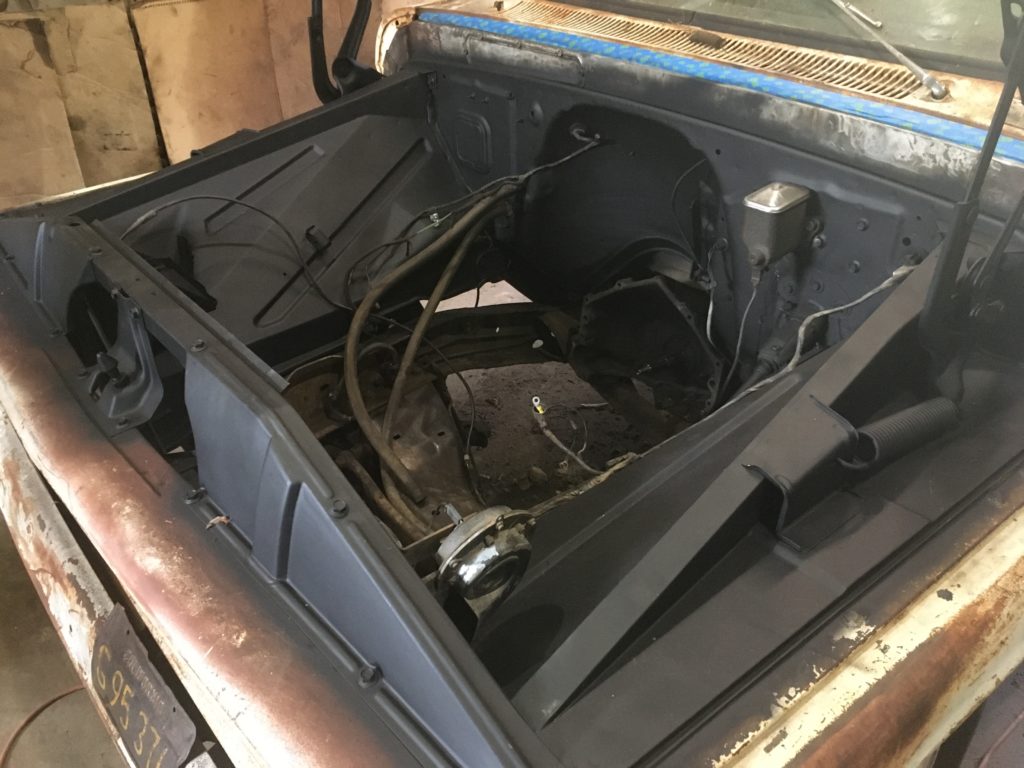
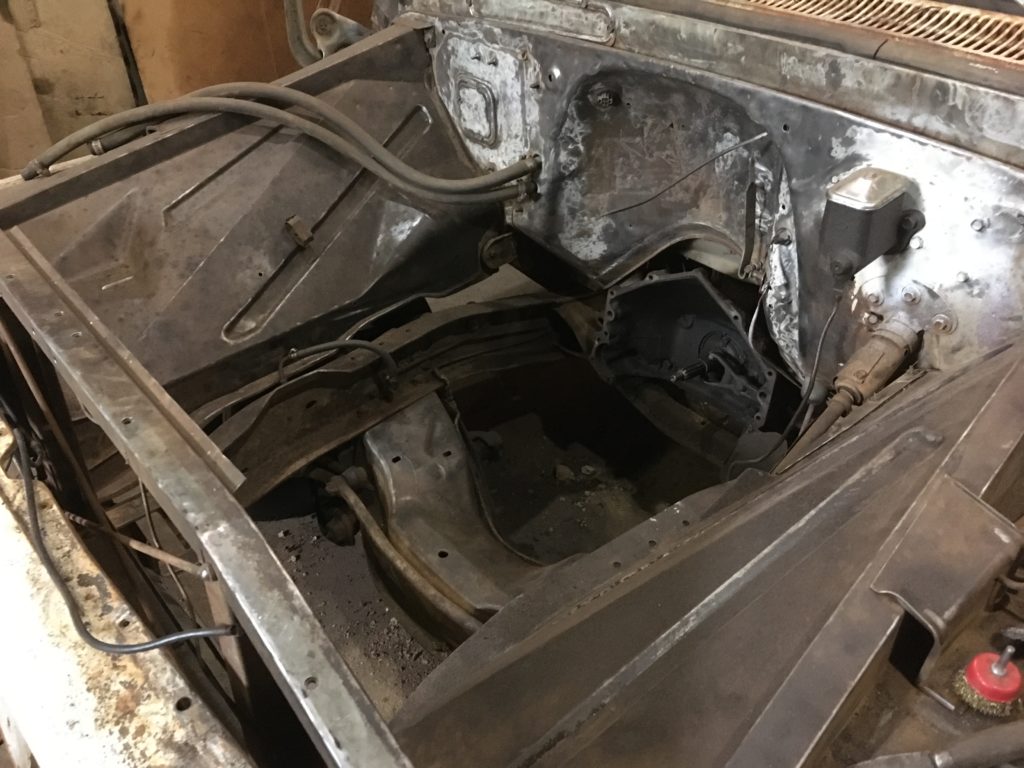
The virtuosity in my life is the one activity I can engage in, which requires physical presence. It is my continued grinding on the metal components of the ’63 Chevy pickup undergoing a much needed transformation. No computer can do this work for me. And that’s okay with me. The truck is a priceless family heirloom my father purchased new. It remained idle after his death, enduring the harsh but dry conditions of the northern California climate near Redding. It now resides in Wisconsin, inside a shop building and is being stripped of old paint and surface rust on its ways to looking like and running as good as new.

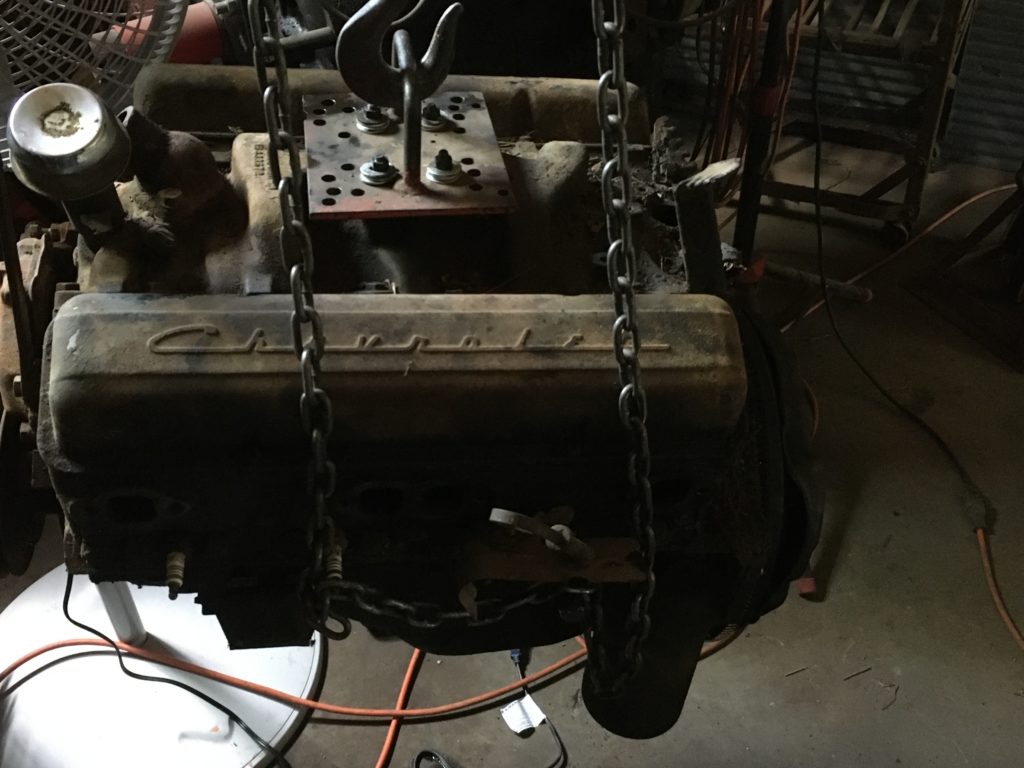
With the engine removed and undergoing repair in a professional shop, the B-team (which is me) attacked the engine compartment with grinding wheel in hand. A younger enthusiast would have found this task dull, perhaps, but easily accomplished with convenient access to the right tools. The tools at hand are the right ones for the job. It’s just that the one wielding them is not. Too many years and too many injuries to back, shoulders, hands and knees means the task requires as many breaks in the action as I can possibly justify. It helps to bring a full thermos of coffee to the job site along with a thirst for caffeine to provide that justification.

No fear. The grinding on this part of the truck’s anatomy is complete. A coat of black primer has been applied as a visible indicator of progress. More grinding is underway. Now I am focused on what is external. Much more coffee will be needed as my virtuosity with the grinding wheel will defy the law of virtuality in other aspects of my life. The dress code, though, is to my liking; jeans, ragged tee shirt and work boots. It is the tinkering man’s appropriate attire.

Chevy Chronicles: Part 4

I am not one for writing about political or social movements as I am not a participant in either these days and my management mantra during a modestly successful career as a non-profit administrator was to never talk politics, religion or football. When you rely on the good faith of donors to power your financial engine, it pays to avoid controversy. That mindset helped to keep me occupied with a lengthy probation period known as gainful employment.

These days if I adhere to this old standard, even though I am now retired, it doesn’t leave you much to write about since observance of the current guidelines for social distancing and self-quarantine keep you from having anything else of substance to talk about. Hence the fact that I can work in isolation in a shop, where I am operating pneumatic tools to grind the decades of rust and grime from the parts of my father’s 1963 Chevy pickup does give me a topic to write about. I also like to provide some photographic evidence of our progress.

When doing this work I do wear a mask. Not that I fear contacting the Covid-19 virus from a car body. But the amount of dust and dirt floating freely off of the crimped wire-wheel attachment of my drill motor could still have a serious and negative impact on my septuagenarian lungs. And who needs an underlying medical condition these days? Things could get worse.

The area of the truck which has received the greatest amount of my attention is the now empty engine compartment. The motor was pulled and completely disassembled, thanks to the mechanical knowledge of my cohort, Dave Lee. The block is in the possession of another mechanic, who cleaned it in preparation for boring the cylinders. Other work of a technical nature beyond my understanding will also be done. I’ll know the details later when I get the bill.

In the meantime I am worrying the metal components needing the type of cleaning I can do. Besides the mask, which keeps me in compliance with the pandemic guidelines, I am faithfully using ear and eye protection. The particulates grinding makes come with their own ability to inflict damage to the human body. I have already been stabbed a few times by small wires breaking free of the fast spinning wheel.  

Life is good, though. The work keeps me occupied and focused on a worthy task. Otherwise I might be likely to generate my own protest against some form of discrimination by some currently unidentified culprit. Give me time to think about it and I will find something to complain about and someone to blame. Fortunately restoring a family heirloom is the antidote of the moment. Hopefully the restrictions imposed by an unseen virus will abate before the final steps in the truck’s return to glory are complete.

A road trip will be in order when that day comes. To fulfill my dream, it would entail the freedom to pursue a destination of my own choosing with the love of my life once again beside me in a physical proximity only a bench seat can provide. I will need to work on my technique for letting my hand casually slip off its hold on the gear shift knob and onto a waiting, compliant knee. The thought of such a moment is the substance of which dreams are made.

Chevy Chronicles: Part 3

It has been several months since I posted an update on the restoration of my father’s 1963 Chevy pick-up. It is amazing how far reaching a pandemic can be in its ability to shutdown occupations and hobbies. The good news is that the easing of restrictions has allowed me to return to fulfilling this old man’s aspirations for driving a vintage vehicle once again with a strong family pedigree.

This is the motorized contraption in which I learned to shift gears, both literally and figuratively. It powered us on many a family vacation, when the over-the-cab camper was attached. It hauled a lot of young folks to the beach, when it was lawful to ride in the bed of a pick-up truck. And on those occasions when it was not loaded wall-to-wall with people, it easily handled a friend and me with our surfboards as the only cargo. It was a rather unglamorous three-quarter ton machine, but it served quite well as a romantic getaway during an inexpensive date. In this modern age of economic car design I think we’ve lost an appreciation for what a bench seat can do for the sake of teenage love. It was not desire under the elms, ala Eugene O’Neill. Just a dark spot on a back road, where no one would likely pass by, their innocence ruining ours.

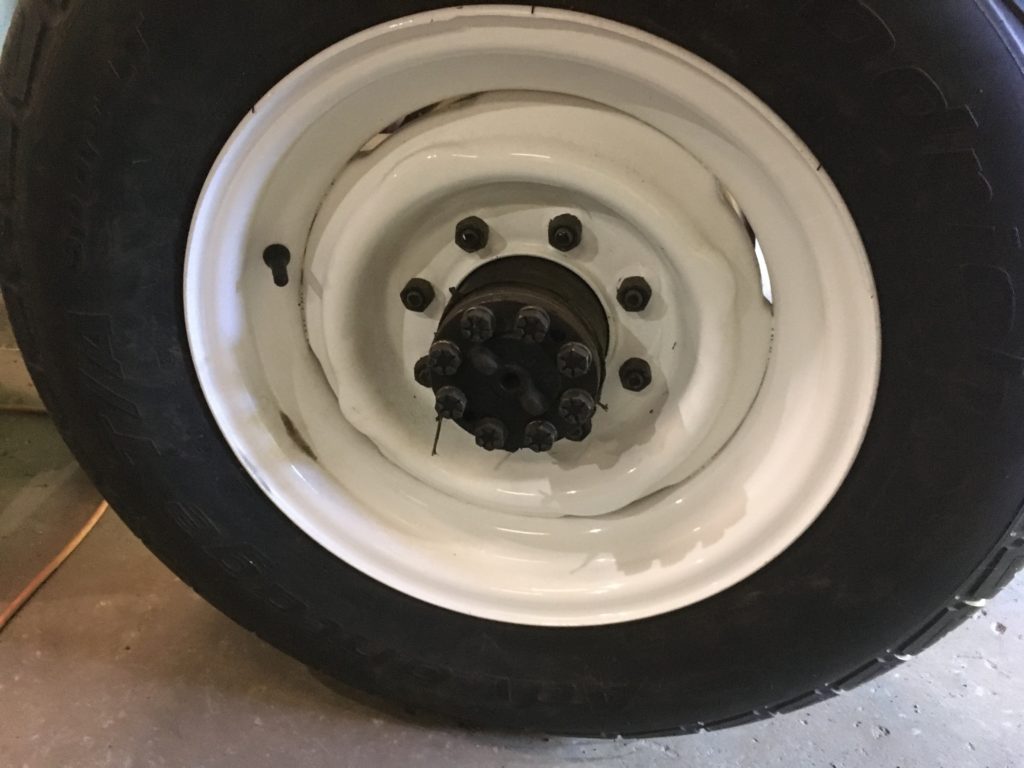
The achievements last fall for the truck’s return to glory were modest. We started on a total rebuild of the wheels and brakes. My part was cleaning parts. My friend Dave’s part was all the technical stuff, resulting in functional brakes, plus the acquisition and installation of new rims and tires. The truck’s first form of transit out of and back into the shop was by people power. Thankfully the wheel work was a success, minimizing the strain on an old man’s back and legs when muscling the vehicle around and about.

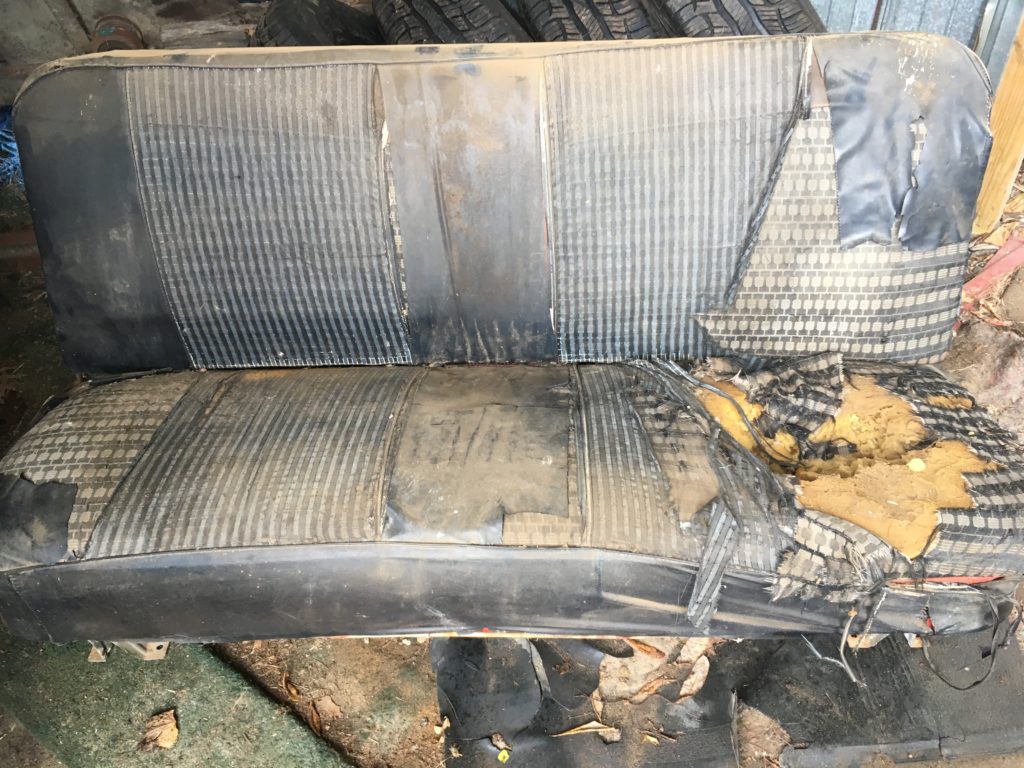
I also put a lot of effort into cleaning out the cab. This required removing that wonderful bench seat along with the behind the seat gas tank. Then we excavated years of accumulated debris hidden in every corner of the cab. What joy there is in eliminating all the nests so carefully constructed by various pests, who inhabited the truck during its many years of sitting idle in the California sun. The seat was shipped off to be reupholstered and a new gas tank ordered to replace the sieve the original tank had become.

All is back now. The seat is being kept under cover, while further interior work takes place. The new gas tank has been installed. It just needs a new sending unit, ordered separately. Rubber floor mats are on order. The doors have been removed and the hinges made functional once again sans rust. Throughout the process minor assessments were made to determine what to do about replacing the missing or damaged requisite for a road worthy machine. The windshield is cracked, rearview mirrors AWOL, and the floorboards in the truck’s bed weathered beyond recognition. There is much to do and since I am not going anywhere, there is ample time in which to do it.  

The next major step is a complete overhaul of the engine. That means the dollar signs are looming ever larger as we make progress towards the truck’s movement – under its own power that is.

Grandma Was a Laundress

Could anything be more innocuous than writing about the laundry? Most of us do our own these days with intelligent soaps, conditioners, fabrics and machines to prevent us from damaging our clothes, while keeping us socially acceptable without the aid of enforced six foot intervals. It’s still a chore, but easily handled thanks to the technology, which has made us a wrinkle-free society.

Cleanliness is important. It has been so for more than a century in the industrialized west. We know about the health benefits of good personal hygiene. We also know, but choose not to mention, its relevance in helping us to determine friend from foe; clothes being an undeniable marker at any distance.

Well turned out attire has served as a convenient means for determining the acceptability of those we don’t know personally but characterize on sight. Cuffs and collars have reigned as social arbiters for generations. They are hard to hide even when we employ the best accessories in coats, vests, scarves and ties. The hint of a stain or wrinkle upon them is an unassailable verification of another’s status as an unworthy acquaintance who is to be politely shunned.

My interest in the laundry, specifically as a once important trade, has nothing to do with any doubts about my own acceptability and everything to do with family history. Previous messages have followed a paper trail about my father’s union work, confirming his role as a reform movement leader for the bakery and confectionery workers during the last half of the 20th Century. Now my attention is on the work of my maternal grandmother, who was a laundress in a small Oklahoma town in the decades prior to my father’s ascent in authority.

I knew my grandmother as a loving matronly type. She lived with us during the school year to help my mother, her only daughter, raise three boys of varying intelligence and social activities. I was too young then to think about her as anything other than an elderly, benevolent family member, who gave me two dollars each year for my birthday. She died at the age of 75 in the year that I turned 13. Her legacy survived in a few black and white photographs we kept in an album and the stories my mother and uncles would gladly share at family gatherings.

From those stories I learned that my grandmother was not acceptable to her in-laws. My research shows that my grandparents had a civil wedding despite their Christian faith and church attendance. I also know that my grandfather eventually abandoned his father’s trade as a cattleman and took up manual labor in the oil fields. His was a common man’s version of an abdication for the woman he loved.

The reason? My grandmother was a laundress. She was beneath his family’s sense of class, which is hard to fathom given that the old man made his fortune running dirty cattle. But such is the fickleness of human sensibilities. The in-laws had the means to build one of the largest houses in town and their clothes were laundered for them where my grandmother worked.

Arwen P. Mohun, associate professor of history at the University of Delaware, wrote in her book Steam Laundries (The John Hopkins University Press 1999) that “Despite the undeniable impact of scientific ideas, ordinary consumers clung more tightly to the symbolic definitions of cleanliness.” Ironically this clinging included the perception of an “indelible lack of cleanliness” in those who did the dirty work of removing stains and odors from other peoples’ clothes. A laundress was “fundamentally ‘dirty’ in a way that no amount of scrubbing could cure.”

My grandmother quit work to raise her family, but her separation from the despicable trade was short lived. My grandfather died in the 1920 flu epidemic after eight brief years of marriage. He left behind a widow with three small boys who was four months pregnant with my mother. The wealthy in-laws did nothing to help her following my grandfather’s death so she returned to the only work she was qualified to do and left her brood to the daily care of her mother and three half-sisters.

She labored in the laundry business until the end of World War II. With three sons and a son-in-law safely returning from their military service, she was afforded the honor of retirement. She lived with her children, rotating for brief bits of time between the four families. But my family received the lion’s share of her love and devotion thanks to mom being proficient at producing boys. Three of us, in fact, just like grandma. My parents, though, had the sense to stop before a baby girl emerged and had the chance to spoil our good life.

Many years after my grandmother’s passing a distant cousin from the “in-law” side of the family wrote about her in his newspaper column. The occasion was a family reunion of those of us descended from a lowly laundress. He acknowledged that such a large and friendly gathering could not have occurred on his side of the family. He attributed the affection shared among as her doing, the result of a character imbued with love and generous to a fault. Near the close of his piece he addressed my grandmother in spirit with the words:

“Lula Fowler Barr, you ought to see the harvest of happiness from the garden of love you tended so well.”

Amen.